Typically I spend a great part of my summer out riding the mountains in north Idaho and Montana. This year we have had very little time for such activities as our days have been spent teaching folks how to ride on the Cowboy Dressage court. Today Dan and I took the morning to go and ride one of our favorite local trails and attempt to put some good trail miles on our young horses.
I was riding my 5 year old gelding who has had a bit of trail time now and Dan was riding his 5 year old mare that has had trail time but not mountain riding. She is fairly steady out there and willing to go just about anywhere as long as she can follow another horse. Luckily, my gelding prefers to be in the lead so it works out well. Dan's mare did great up the hill and kept up with little trouble. Going down the hill was another matter all together.
Dan really struggled to get Cali to willingly go down the hill in a collected and balanced frame. She would instead hollow and throw her weight to the front end and barrel down the hill like somebody popped the clutch. When Dan would try to slow her down he would end up bracing his feet, the back would get more hollow and she would trip on the rocky ground we were traversing.
Not a fun way to spend an afternoon and Dan was getting pretty frustrated as well as pretty beat up. We got to talking about it on the way down and discussing options to help her figure it out. Dan's previous mounts just naturally balanced themselves going down hill and he never had to help a horse figure it out before. I've not been so lucky. All of the young horses I have put trail miles on were the same going downhill. Maybe it's my bad luck in the mounts I've chosen, but I have found that it takes some time and patience and not to mention some nerves of steel to develop a good balanced down hill gait in most horses.
You would think that this would be a none issue for a horse, wouldn't you? Shouldn't the horse naturally know how to walk down hill? Perhaps a horse raised out on open range that has been navigating hills since it was a foal will not have these issues. I don't know because I haven't started one like that. But my horses are raised much like a lot of folks horses on fairly level ground and then trained in a round pen and an arena. We get ours out on the trail pretty early but those are short little drops without long steep down hill inclines. Just because you have been walking your whole life doesn't mean you know how to properly balance going down a steep incline with a big pack on your back. It takes some time to figure out. So, those of you who may struggle with this in your own horses, here is how I help my horses learn to go down hill.
First your horse has be far enough along in his training to understand to break at the poll and soften through the head and neck. I honestly don't have a clue how you would slow one down who couldn't do that because everything else I'm going to talk about starts there. If you can't get vertical softness and support the horse that way, you are probably going to have trouble stopping the forward momentum down a big hill. Teach the horse to round and soften to rein pressure first just at the halt and then again as you work through the walk and jog. You have to have a good brake with vertical softness because you cannot rely on the one rein stop on those trails. Quite often the most dangerous trails are the narrow sheer steep rock trails. If you can't regulate your horse's speed without bending them around in a circle you better just let them coast to the bottom because getting to their feet may end up in you tumbling off the cliff side.
Before you embark on the down hill part of the trail, take a moment to put the horse together beneath you. Shorten your rein and elevate the head and neck just slightly with softness at the poll. This helps to shift the weight from the front end to the hind end. If you wait until your horse is already careening down the hill it may be to late to stop that foreword momentum.
I don't lean very far back in my saddle going down hill. I can remember in 4-H we were taught to stay parallel to the trail. So you would lean forward or backwards at the same angle as the ground beneath you. What ends up happening if you do that is that generally going up hill your standing in your stirrups with your feet far behind you and going down hill you are leaning far back over the cantle with your feet jammed in front of you. Anyone who experiences pain in their knees or ankles when doing long days in the saddle in the mountains, this is why. You are bracing on your feet instead of keeping an active seat. As with any form of good riding, your seat is very important as an aid. You aren't just a passenger up there on the horse's back but responsible for helping the horse to adjust his weight with every stride. If you are taking all the weight in the stirrups you become a big lever on his back instead of a part of his stride. I do lean a little both forward and back as the hill dictates but try to always keep my seat engaged and my legs balanced beneath me.
This balance becomes very important when helping the horse to learn to shift his weight to his hind legs. In a horse that tends to barrel down the hill he is probably leaving his hind end out behind him instead of driving it forward. If you soften the poll and elevate the head and neck you can ride the hind end forward and up under the horse and encourage him to shorten his frame. (For you Cowboy Dressage folks, this is why mountain riding is so good for the building short frame in your show horses!). To do this you would raise your hands just slightly on the shortened reins, deepen your seat a little and move your legs back on the rib cage to talk to the hind legs and ask them to come forward one step at time. Then you are taking the impact of the down hill movement on your seat and thighs and not on your knees and ankles.
The other important safety tip when helping a horse to learn to go down hill in a collected frame is to not get into a fight with them. My Morgans often feel they are the ones who know best about the speed necessary for down hill flights and it can be a challenge to convince them I may have a better idea. If the footing is at all rocky or dangerous, like I mentioned above you don't want to take their attention away from the footing by bumping or pulling their heads around to stop them. Instead draw the horse to a stop with firm pressure on both reins until his feet stop and he softens at the poll and you can collect his frame again before asking him to move forward. This is one of the only times I advocated direct pressure on both reins. Be sure that you are riding with a bit that pressure on both reins isn't going to cause the horse to react by flipping or popping up. Keep your hands low and hold that pressure backwards until the horse stops. When the horse has stopped completely give him a chance to settle, pet his neck and breathe then soften the poll, ride the hind end forward and ask again to move down the trail in a shortened frame.
Another common problem for young horses learning to navigate down hills is for the horse to get crooked. This is generally due to the rider attempting to shorten the stride and slow the horse. Rather than the horse stepping up underneath themselves they attempt to evade that frame and step the hindquarters sideways. On steep mountain trails this can lead to tripping and falling off the mountain. Use your legs to keep the horse straight underneath you. Again, if it's not working and the hind end is attempting to pass the front end, draw the horse to a stop and start all over.
Now, we don't always want to have to help our horses down the hill. It's a lot of work and if you are doing 25 miles you do actually like to stop for a minute and just ride and enjoy the scenery! Creating the horse that can navigate a trail with some self carriage, no matter the terrain is what every long distance rider has in mind for his perfect trail mount. So, riding the brakes down the hill is not conducive to building self carriage in the horse. As with everything we do, when the horse is going down hill and softens and gets into the proper frame beneath you it is important to release the reins and reward the horse and see if he can carry it forward for a few steps by himself. You may need to pick him up and balance him after only a few steps but the release is important if you want to avoid having to carry the horse down every hill for the rest of his life.
I sure hopes this helps some of you that may be dealing with a run-a-way horse down the mountain. Great trail horses are not born, they are made. A good trail horse should really be the best broke horse in the barn. All that fancy arena stuff is even more important when you get out into the great wide open. Do your homework to make your horse safe and sane and perfect partner out on the trail or you may wind up walking home the hard way some day! Happy trails!
Thursday, July 7, 2016

Wednesday, March 23, 2016
It's Now or Never
I am a very lucky lady.
Believe me I know that. I’m
living the dream working in the area I grew up in and doing a job I picked out
as a star struck 10 yr old. I have a successful
business, a wonderful marriage and I make a comfortable living. It would be easy to say, “I’ve made it!” and
settle comfortably into getting on with the business of day to day living.
But that’s not who I am. I am a driven person who has always enjoyed pushing myself to the limits of what I think I can achieve. Learning is a life skill and I am a passionate learner. The only other thing I’ve ever wanted to do with my life besides be a veterinarian is be a horseman. So, now that I’ve reached my first goal it’s time to attack my second. I’ve set my goals on the trail of learning as much as I can about the art of horsemanship.
I think many people can relate to what I’m talking
about. I hear over and over again as I
travel and teach on my weekends off that they wish they could go to a show, or
a clinic, or travel to see an event. If
only time would allow. I hear a lot of
somedays, and maybe whens and once I’ves.
I used to say those things as well.
As a solo practitioner for 10 years, days off; not to mention weekends
off, were a dream that was far out of my reach.
The profession that I had chosen and loved just about did me in in a
short span of 10 years of hard work. I
didn’t even take the day off to get married.
I did a castration on the way to the wedding and a plasma transfusion
hours after the ceremony. My clients
were incredulous and very grateful but not one of them said, "Good grief, no,
don’t come today!"
Thank goodness, for my sanity and the well-being of those
around me that all changed when I was able to find a partner willing to share the
load. I thank my lucky stars every
single day for that lovely lady who takes calls two weekends a month so I don’t
have to. Finally, I have to opportunity
to pursue a life beyond just my career.
Maybe it was going to so long without it that made me realize how very
important and precious my time is. Sunday, January 17, 2016
To Spur or Not to Spur.
Folks that know enough about me to know I’m a big proponent for light riding and softness are often surprised to learn that I wear spurs when I ride. Some have even gone so far as to jokingly say, “I’m wearing spurs, don’t tell Jenni!” Like many of your tack choices, the decision of whether or not to wear spurs is a personal one. We know that any piece of tack can be mis-used and abused, but let me explain a little about why you’ll generally find a pair of spurs residing on my boots.
When deciding whether or not to use an item of tack it is important to understand the purpose and historical uses of that piece of tack. Using an item just because, say, Trevor Brazil, for example, does it that way isn't the way to make choices for your horse. No matter how badly Cactus and Cinch are hoping that's all that drives your purchases!
 |
| early roman prick spurs |
One of the earliest evidence of spurs used in riding were found in graves unearthed in England and were worn by the romans under Julius Caesar. The spur was originally devised as a way to aid in directing the horse other than by rein or whip so that the hands would remain free during battle. The original spur was a sharp pointy projection called a prick that would look somewhat brutal by today’s standards. We can see variations on this theme all through the early centuries following the death of Christ. There are examples from the 11th and 12th centuries in the British museum. The Mongolians wore prick style spurs as early as the 13th century.
 |
| prick spurs used by the knights |
The rowel spur as we know it today originated in France in the early 13th century and gained in popularity and distribution for the next 100 years. During the reign of the knights, the spur became a mark of status and rank. “Earning your spurs” meant that you had proved yourself chivalrous and worthy of the precious metals and adornment.
As plaited armor for horses began to be used in combat, a longer spur was necessary to reach the horse’s side for communication. The long shank, sometimes up to a foot long was common in the 16th century until the armor requiring that length began to fall from fashion.
 |
| Long shanked spurs meant to reach around the horse's armor |
Because the spur was not only a practical tool but also something to which adornment could be tastefully added, the spurs began to be more and more elaborate in design. The Spaniards probably took that adornment to the next level.
 |
| Spanish spurs, 18th century |
The ornate and largely roweled spurs that we see in our western heritage came to the new country with the Spanish conquistadors. Worn as status symbols by the brave men chosen for these expeditions they were soon copied by the Mexicans and are still seen in Mexico and South America today.
The US Calvary initially favored a more English style spur with a short shank and small rowel. By 1882 those spurs were solid brass and were used in that style until World War II.
Spurs were a part of the officers uniform and there was even an official "dance spur" that officers could wear to formal social engagements.
 |
| US Calvary spur, Civil War era |
Modern Spur
Today’s spurs are generally more understated than the large ornate spurs that we saw with the early Californians. Ranging from blunt tipped to rowels of all shapes and sizes the spur is as individual as it’s rider. My favorite pair of spurs is small with a clover leaf rowel. It is blunt and is used not only as an extension of my leg but as a tool for refinement.
 |
| Some modern variation in spur design |
I like to compare the use of the spur to typing. My horses, once they get advanced enough have many buttons on their sides, just like a key board. One button by my the cinch may move the rib cage over, while a button just a few inches back from that may move the whole horse sideways. Then an inch behind that, the hip only will move. When I am trying to make correct movements with precise control I don’t want to push on the buttons with my whole calf, or with my heel. I like to lightly touch the button I need just like I was typing. Lightness with my legs and spur is just as important as lightness with my hands.
“Thou Shalt Not Dwell with Either Rein or Spur” - Jack Brainard
You wouldn’t want to have to type a dissertation with your fists. Being precise and understood would be quite difficult. My horses are light and responsive enough that a muffled conversation interferes with the quality of the response that I get. It's not that my horses can't respond to my cues unless I wear spurs but with spurs I can whisper in full sentences. Without them it's more like shouting and grunting.
That's probably oversimplifying the use of spurs a bit as a really well trained horse should be able to respond to the lightest shifts in just my body and seat. But, like the well trained horse that is quite capable of riding bridle less, he is that much more amazing in the bridle.
One of the other things I really enjoy about spurs is the noise. Indeed this is a feature that has long been realized for its usefulness to the end that many horseman in history attempted to make the noise of their spurs even more rhythmic through the addition of heel chains or jingle bobs.
 |
| Heel chains |
Heel chains are worn on the bottom of the boot and if they were tighter might look like their purpose was to help hold the spur in place, but in reality the bouncing rhythm of the chain on the riders heel helps the horse to find and stay in a steady cadence, especially when on a long free jog covering ground.
 |
| Jingle bobs |
The jingle bobs are small little bits of metal resembling charms on a bracelet that hang from the rowel and have the same purpose as the heel chains. They make a rhythmic noise as the horse and rider move together.
So, do I broadly recommend spurs for every rider? Definitely not. There are a few reasons why you may not choose to wear spurs with your horse. If you are a green or inexperienced rider still finding good balance and learning how to have an independent seat, spurs may just get you into trouble. While we generally use the spur to whisper, when used with force or in the wrong place they sure can yell to the horse. I typically don't even wear spurs on my really green or nervous horses until I can be sure (or as sure as one can be) that they aren't going to pull a move that may have me gripping a little tighter than anticipated with my spurs. I typically wait until after the first 15 rides or so.
I also don't like to see spurs used on a horse that is reluctant to move forward. Spurs used in such a fashion to get forward on a horse will dull the horse in my opinion. If you need spurs to make your horse move forward you need to find another tool to communicate because your seat isn't working and I would suggest a crop or dressage whip. The spur used in the rib cage is for movement of the body laterally. This is why you don't see jockeys riding with their legs in a spurring position. Forward is established through the hindquarters and the spurs are not terribly efficacious for moving those hindquarters anywhere but laterally. Sure, a pair of spurs applied liberally to a stubborn horse can and will get them moving forward but in time you will always have to use those spurs to move them forward and eventually you will have to use those spurs for every stride. Then you may as well be riding a bicycle for all the peddling you'll have to do. This is why the spur stop used by Western Pleasure horses works. If spurs were good at moving a horse forward, training it to stop by driving a spur into it would never work.
So, if you are ready to attempt to refine the cues you are using with your horse, or would like to improve the quality of the response you are getting from your horse I highly recommend the competent and judicial use of spurs. You'll have to experiment a bit to find the spur that's right for you and your horse, but, don't be afraid to use the spur because it's "mean" or "brutal". It's no more mean or brutal than the rider.
Saturday, January 9, 2016
Seeking Partnership
Seeking Partnership
I’ve been remiss in my blog entries lately which is a
function of my high level of frustration.
When I’m feeling inspired and focused and making progress I find clarity
in sharing my experiences. Lately I feel
like I’m banging my head against a wall and it’s a bit harder to share! But, sometimes stepping aside to look at your
horse, your horsemanship and your progress can help in times of frustration, so
here goes.
I’ve written about my gelding Kit before. He has been more challenging to me in my
horsemanship than any horse I have had in a very long time. For every step forward I feel I take two
steps backwards. He was the horse that
bucked with the saddle every time for the first 12 times he was saddled. Not just crow hop around but honk and buck
himself into a standstill. He was also
the horse the pitched me, hard. He is
the horse that I gave in and called for help in starting and sent out for 30
days of professional training with one of the best colt starters that I know.
That was fall
2014. This year I worked hard on trying
to get him softer, more reliable, less likely to dump me at the slightest
provocation. He is smart, sensitive,
powerful and athletic. A volatile
combination at times. He is also
incredibly busy minded. Standing still
is a ton of work for this horse. He has
had countless hours on the highline and will eventually stand still but prefers
to chew on the rope, the tree, his feet, my saddle, whatever is in reach.
I did make some progress with him this year. I got him out on a couple of trail rides this
summer; one in which he got into a mess of bees. I was sure that would spell instant death
with this horse but he manned up and took me out of there without a hitch. I was never so proud of him. We have spent hours and hours on groundwork
attempting to get him soft and responsive as he tends to have a bit of an
opinion about things, well, all things actually.
The one thing that I feel I am always struggling to maintain
and cultivate in this horse is partnership.
Join-up. Being hooked on. Whatever you want to call it, it’s lacking in
our relationship. Don’t get me wrong, I
think he enjoys our sessions and I love the heck out of him. But, I feel like he is always looking for the
next big thing. The new horse in the
arena to check out. The new person to go
meet. The tree, over there, that looks
way more interesting that the tree over here where there is actually a trail. With groundwork it is always the same. I am constantly saying, either through voice,
rein, or flag : “Hey, attention here, please.
No, seriously, here. Right
here. HEY!”
So, now I have him in winter training. He is boarded at a local indoor arena owned
by a good friend of ours. It’s a lovely
facility and we are lucky to have our horses there. With the weather this year
I wouldn’t have the opportunity to ride and train without it. We have had a ton of snow this year and
unfortunately a big metal building covered in 2 feet of snow causes a lot of
roof slide off. If you are not familiar
with what it sounds like when several hundred pounds of snow comes crashing off
a metal roof, Kit would like to explain that sound in his own words:
“The sky is falling, the sky is falling RUN FOR YOUR
LIFE!!!!!”
Now, you would think that eventually it would become obvious
that the sky is indeed NOT falling and it’s just snow. Again.
But Kit either isn’t that smart or he knows something the rest of us
don’t know because he is thoroughly convinced that death is immanent when he
hears the slightest sound indicating possible snow movement. I can’t help but feel if I had better
partnership established with this horse he may do a little more looking to me
for comfort and guidance rather than leaving the country without glancing back
to see if I was even coming.
To say it’s made his already short attention span even
shorter is an understatement. He’s a
basket case and to be quite honest with you I’m struggling to figure out how to
help him. Just when he gets relaxed and
thinking a chunk of snow breaks loose and BOOM there goes his heart rate. Keeping him busy and moving and thinking is
working to a certain extent but because he wants to keep one eye on the opening
by the doors just in case he might need to make a sudden break for safety I’m
having to do a lot of redirection, and repeated requests for softness,
partnership and focus.
So, I have come to really pity the elementary teachers asked to try and get ANY teaching done the day before Christmas break or on any other holiday. Teaching when your student is absolutely incapable of sitting still and paying attention is an exercise in futility. This horse is ALWAYS the ADHD student. Now he’s the ADHD student on sugar, caffeine and suffering from watching horror movies late into the night.
Don’t get me wrong, I don’t intend to give up. I’m not that kind of person. It’s possible that I SHOULD give up, but it’s not going to happen. I’m going to continue to explore with both soft feel, suppling, driving and other exercises both on the ground and in the saddle and hope we don’t ever part company when a big chunk of snow gives way. Maybe somewhere in the middle of all this kerfuffle I’ll discover partnership and Kit will look to me as his savior, leader, alpha, beta or whatever terminology you would like to assign to that lovely equine Zen that occurs when you and your horse are one.
I would love to tell you about all of the great exercises we
are working on this winter to build soft feel and create bend and improve gait
quality. I would love to share how you
can feel the muscles of softness and beginnings of collection start to build
over your horse’s top line. I would love
to start building towards soft lope departures and the short jog. Instead, I’m a 3rd grade teacher
on the last day of school trying hard to engage the students in Simon says and
hoping that something is getting through while they bounce off the walls. Heck, I can’t even get him near the wall!
Friday, January 1, 2016
Year in Review
 |
| Chico and I doing "groundwork" Jan 1 2015 Photo Credit: C. Holloway |
 |
| Riding with Dale Rumens-Partee Jan 1 2015 Photo credit: C. Holloway |
2015 was quite a year. It began on New Year's Day with a Cowboy Dressage clinic in the frigid temps and that set the tone for what would be the busiest year I've had in a life of busy years. Learning, teaching and competing in Cowboy Dressage was the theme of 2015 for sure.
I never set out to be a teacher. My goal has always been to be the best horseman I could be, whether by serving the horse through veterinary medicine, or more recently by improving my personal horsemanship skills to better my ability to handle and talk to my horses and my patients. It was reluctantly that I took up the mantle of Cowboy Dressage Professional.
 |
| Teaching in Stevensville, MT |
So, with the urging of Eitan and Debbie I hesitantly booked my first clinic in May of last year. I had a vague notion of what I would teach for the two full days and hoped that I could pull it off and at least present Cowboy Dressage in a good light so that the folks involved would be inspired to continue on. Of course, that first clinic was smack in the middle of breeding season so I worked like a dog to get done with work to make it out there then had to drive home after the first day of the clinic to breed a mare and then return first thing in the morning to continue the clinic.
 |
| Teaching in Colville, WA |
After my first clinic I wasn't sure if anybody else would be interested in learning from me but the calls just kept coming in. With each group of horses and riders that I taught I realized how much I was learning as well. Teaching is a wonderful way to improve your own skills and discover new ways to look at a problem in a horse or rider to help them find the solution. I found I really enjoyed getting on other folk;s horses to see how the horse was responding so I could better help them communicate.
There is no greater reward for me as a teacher than seeing not only the rider get it, but for the horse that may have been defensive, resistant or fearful finally relax as suddenly the communication from the rider makes sense.
I used to spend my weekends off trail riding and exploring the hills and mountains of North Idaho. I didn't do more than one or two local trail rides this year. Instead I spent my weekends off traveling the Northwest spreading the word about soft feel, harmony and partnership and Cowboy Dressage. I don't know if I've ever worked harder in a year or enjoyed it more.
We also dove head first into the competitive side of Cowboy Dressage this year participating in as many of the gatherings in the region as we could attend as well as participating in the Final Gathering and the Top Hand competition.
 There is nothing like the crucible of competition to really push you to work hard and meet your goals. Both Dan and I worked hard to improve our scores from one gathering to the next. For me, personally I have never trained so hard for a single event as I did for the Top Hand competition this year. I learned how much progress you can make when you really and truly dedicate yourself to a goal. It was also reinforced on me how important your foundation is in Cowboy Dressage. It doesn't matter how well trained your horse is if your partnership with your horse isn't solid. Participating in the Top Hand was exciting, stressful and it pushed me past my limits in horsemanship and showmanship. It's definitely something that I will participate in again.
 |
| Dan winning reserve high point rider. Nov. 2015 |
Dan worked so hard this year that he went from most improved last year to second place overall at this year's Final Gathering. A testimony to the beautiful partnership he shares with his little red mare, Salsa and the time and effort that they put into preparing for the big Gathering.
As I look back on 2015 I am reminded of all the new friends I have made. I'm reminded of the wonderful horses that I have met. I'm reminded of how far I personally have come in my horsemanship goals.
My goals for 2016 read much the same as my goals for 2015. I want to improve. Always. I am lucky to be a passionate participant in a life sport that provides infinite opportunities for personal growth and learning. I learn something every single time I touch a horse. It's the number one reason why this sport is so addictive to me. Finding a niche, like Cowboy Dressage that includes soft feel and partnership as the cornerstones just makes me more passionate. I can reach my goals through methods and means that encourage and foster the relationship I have with my horse. I suspect, looking at my calendar for the coming year that this year may be even busier than last. Squeezing as much life and riding out of the year as possible. Every year my I see my friends make resolutions to ride more in the coming year. I am lucky to say I don't think that is possible for me without retiring! Every moment I'm not working as a veterinarian will find me mounted and working on one of my horses.
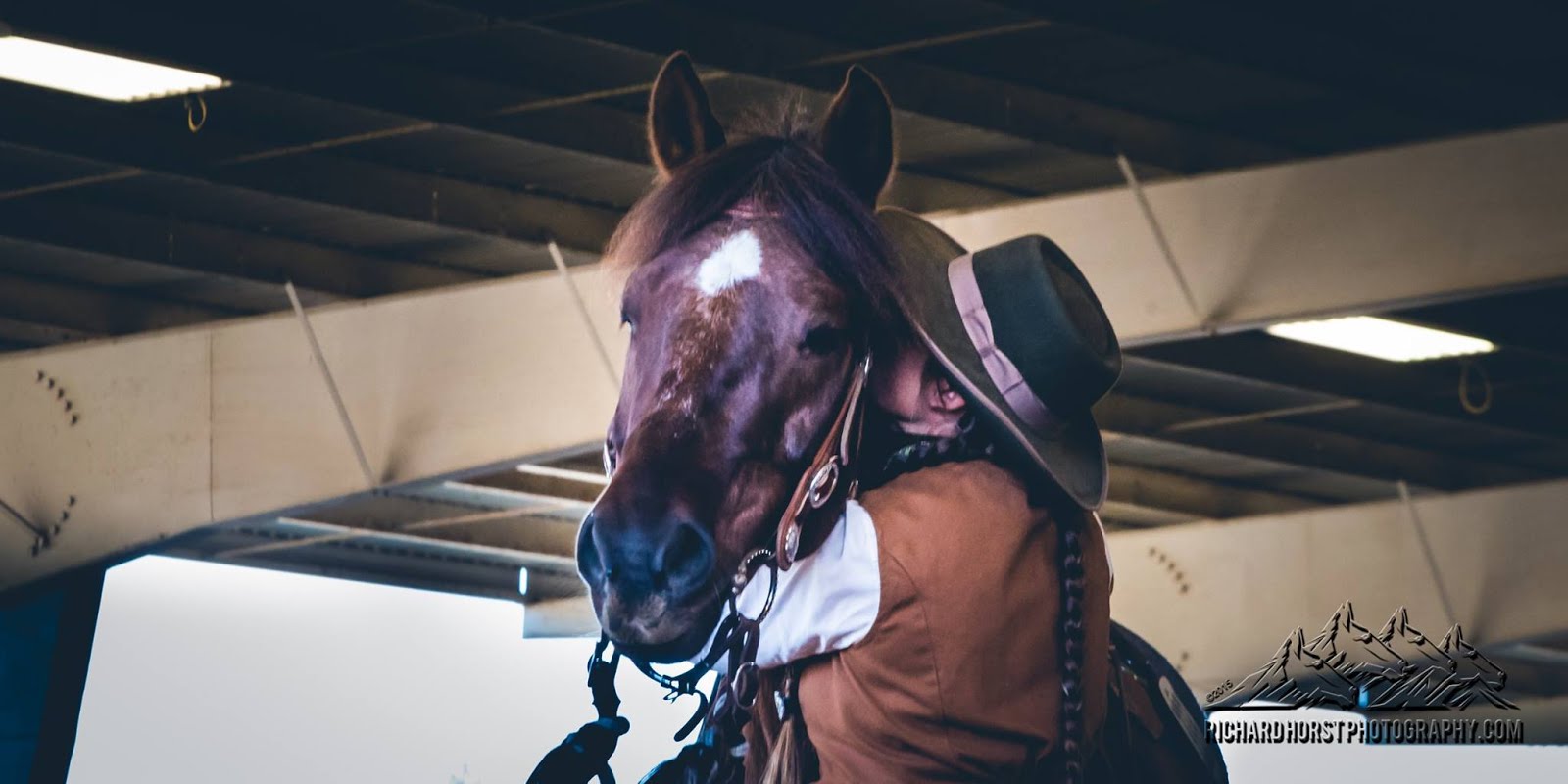 |
| Chico and I at Finals in Nov 2015, Photo credit: R. Horst. |
I plan to spend today much as I spent the first day of 2015. We'll be on the Cowboy Dressage court working on improving our soft feel and developing harmony with our horses. I'm excited for 2016 and the new things that Cowboy Dressage World has to offer. I'm proud to be a part of the Cowboy Dressage family and hope that I can continue to spread the word to horse folk ready to learn how to improve their horsemanship and just enjoy their horses.
Tuesday, September 29, 2015
There is no Drug Like Lightness
This horsemanship journey is such an unusual experience. I would say that my equine education has been in many ways more difficult and challenging than obtaining my veterinary degree. Wouldn't it be wonderful, if when confronted with a difficult problem with your horse, you could just hit the books and find the answer? Or do a blood test and discover the source of the issue at hand? Being a vet is easy stuff compared to being a horseman.
If I could pin point the one thing that really kicked me off on this journey or quest for equine zen and the one thing that keeps me striving each and every day to make myself better it would be lightness. In reality I'm likely a shiny newbie when it comes to truly knowing what lightness is. When I watch master horsemen at work, you can't see them move. You can't see them touch the reins or cue with their legs. That's lightness. When the horse and the rider move through space as one body and one mind. That's lightness. At the point that I am at in my horsemanship journey I have mediocre lightness that comes and goes. But every time I get that glimpse of what true lightness and partnership feel like it about makes me cry. It's that kind of overwhelming feeling that makes you want more, right now, and lots of it. That's the addictive part.
You see, lightness is like a drug. It's more addictive than cocaine, meth, or any of those other substances that causes folks to lose great parts of their lives in pursuit of their next fix. For those of us on the quest of true lightness, it defines our journey with our horses. It's part of everything that we do. It encompasses every thought that we have about our horses and how we handle them. For those of us that are truly addicted, it is what we dream about, night after night.
You may think I'm being a bit dramatic or romantic about this, but that is just because you haven't gotten properly addicted yet. I am at that part of my journey where my addiction is such that it has begun to get in my own way of progress a bit. I discovered just how crippling my addiction can be this past weekend.
I've made tremendous progress with my horses this summer, most especially with my gelding Chico. We are finally, after 10 years together beginning to really cultivate lightness. There are times when I'm riding him that our partnership is such that all I have to do is breathe or think it and it happens. I can just turn my hips and he bends his body lightly around my inside leg. He is lighter in the snaffle than he has ever been. He is soft in the bosal. Though I haven't put him back into the bridle yet, I think the transition and results are going to be great.
The problem is, that like all horses, Chico's partnership and softness come and go. I know in my heart of hearts that this is normal for every horse and rider. But once you have felt the lightness that is there and possible, the absence of it is almost more than I can bear. Because I am so addicted to the feel of that lightness, when it leaves, it is almost heartbreaking for me. It is especially bad on those occasions when the loss of lightness is accompanied by the complete loss of partnership. It feels like every step in the right direction you have made over the past months has just been wrenched away.
It's those moments when lightness leaves that I can really experience the "downer" of coming off the lightness drug. This past weekend Chico and I participated in a Cowboy Dressage retreat on the beach in Washington. While it was our first time to the ocean, Chico and I did participate in a group beach ride a few years ago on a reservoir. At that time, all that open space and horses loping by in the sand completely cooked his goose. It was all I could do to keep him underneath me and not racing away into the distant horizon. I had him in the bosal at that time and the best I could do was ride in a series of small circles that acted like a centrifugal sling shot flinging us down the beach until we were back in the trees again and he felt somewhat more like himself.
While I wasn't expecting anything of that sort on this trip, I bring it up to remind myself of how far we have come from that time. This time I had Chico in the snaffle. We were able to lope and play in the sand and the surf with only moments of checking out. It was while I was trying to work on loping 20 m circles that we had the worse downer time.
The other horses in our group are natural lopers. Chico is not. I have to work hard to hold him together in the lope. He wants to get strung out and he blows out on his circles through his shoulders, drops gait into a terrible bone wrenching trot and then throws his head in the air. Sounds fun, eh? Well it feels miserable. I've been mostly able to contain that mess and keep things soft this year, but with the sand, surf, kites, wind, wide open spaces and everything else, our circles were not perfect and soft at all. Or at least they didn't feel that way to me.
As I struggled to mold my horse back into an semblance of softness and collection beneath me I really began to struggle as an addict of lightness. Instead of remembering that this is hard for Chico, how far we have come and remembering to go back to those moments where he feels good I continued to fight and struggle for the lightness that wasn't coming.
What's the adage of the insane, "A lunatic is someone who continues to do the same thing but expects different results"? Yeah, that was me, getting more and more desperate for the lightness I was craving until I couldn't see the waves, or the sand or anything around me anymore but a red haze of frustration.
While my friend and clinician, Dale, attempted to cheer me up and said things really had looked pretty good out there I knew that the feel of it wasn't what I had been after and all I could do was concentrate on the lack of lightness that I was craving. Finally, she sent me off to recoup and refocus and regain a little perspective.
I walked off, breathing deeply as my horse attempted to regain some air after loping circle after circle in that beach sand. Eventually the haze in my head cleared and suddenly I could hear the waves again. I looked up at that gorgeous sight of blue sky, white waves and blue ocean and remembered I was lucky to be riding in such a beautiful place. As Chico and I slowly walked off down the beach I suddenly realized that I was quite a ways away from the other horses; something that wouldn't have happened without a mental breakdown for Chico even 6 months ago. We were on a section of brand new pristine beach. The perfect place for a fresh start.
I began to create figures in the sand. First soft 10 m circles at the walk, then jog, then 20m circles at the free jog, keeping my breathing and cues light with Chico's breathing. He stayed with me in partnership and lightness. Before I knew it we were loping circles again. I'm not going to say they were perfect (I'm waaayy to much of a perfectionist for that!) but they sure were improved. The lightness and partnership were back.
So what did I learn from that? I learned that lightness is wonderful and is of course our goal, but when it's not there like we really want it to be it's not the end of the world. Lightness comes and lightness goes. Our horses can have off days, get distracted, get sore, or just plain decide today isn't the day. We cannot ride the horse we had yesterday nor can we punish the horse today for not being what we want him to be tomorrow. All we can do is ride the horse we have today the way he is today in hopes of what he might be tomorrow.
If any of you have seen Buck the film you've heard his quote about lightness. I can't remember exactly how he phrased it, but it was something like this: If you could get even a glimpse of what I'm talking about, you would spend the rest of your life trying to get a piece of it. I guess my problem this past weekend is I was trying so hard to get a piece of it, I lost the reason for the journey in the first place. Instead of waiting for my horse and I to go together I tried to force my horse to come back to me, insisting that he get soft and respond like I wanted him to because I wanted that softness so badly. What I should have done is stopped everything and gone back to place where it felt good and tried again to get him to come along with me.
Leave it to a druggy to be so anxious for another hit he hurts the ones closest to him. That's what I was doing to my horse. I wanted so badly to be one with him that I forgot to be the kind of rider that a horse is going to want to have a partnership with. Next time I will try to remember that this dance takes two. It takes a leader and a follower in partnership together. I'll try to remember to lead not only with lightness, but with grace and dignity that any partner would be proud to be a part of.
If I could pin point the one thing that really kicked me off on this journey or quest for equine zen and the one thing that keeps me striving each and every day to make myself better it would be lightness. In reality I'm likely a shiny newbie when it comes to truly knowing what lightness is. When I watch master horsemen at work, you can't see them move. You can't see them touch the reins or cue with their legs. That's lightness. When the horse and the rider move through space as one body and one mind. That's lightness. At the point that I am at in my horsemanship journey I have mediocre lightness that comes and goes. But every time I get that glimpse of what true lightness and partnership feel like it about makes me cry. It's that kind of overwhelming feeling that makes you want more, right now, and lots of it. That's the addictive part.
You see, lightness is like a drug. It's more addictive than cocaine, meth, or any of those other substances that causes folks to lose great parts of their lives in pursuit of their next fix. For those of us on the quest of true lightness, it defines our journey with our horses. It's part of everything that we do. It encompasses every thought that we have about our horses and how we handle them. For those of us that are truly addicted, it is what we dream about, night after night.
You may think I'm being a bit dramatic or romantic about this, but that is just because you haven't gotten properly addicted yet. I am at that part of my journey where my addiction is such that it has begun to get in my own way of progress a bit. I discovered just how crippling my addiction can be this past weekend.
I've made tremendous progress with my horses this summer, most especially with my gelding Chico. We are finally, after 10 years together beginning to really cultivate lightness. There are times when I'm riding him that our partnership is such that all I have to do is breathe or think it and it happens. I can just turn my hips and he bends his body lightly around my inside leg. He is lighter in the snaffle than he has ever been. He is soft in the bosal. Though I haven't put him back into the bridle yet, I think the transition and results are going to be great.
The problem is, that like all horses, Chico's partnership and softness come and go. I know in my heart of hearts that this is normal for every horse and rider. But once you have felt the lightness that is there and possible, the absence of it is almost more than I can bear. Because I am so addicted to the feel of that lightness, when it leaves, it is almost heartbreaking for me. It is especially bad on those occasions when the loss of lightness is accompanied by the complete loss of partnership. It feels like every step in the right direction you have made over the past months has just been wrenched away.
It's those moments when lightness leaves that I can really experience the "downer" of coming off the lightness drug. This past weekend Chico and I participated in a Cowboy Dressage retreat on the beach in Washington. While it was our first time to the ocean, Chico and I did participate in a group beach ride a few years ago on a reservoir. At that time, all that open space and horses loping by in the sand completely cooked his goose. It was all I could do to keep him underneath me and not racing away into the distant horizon. I had him in the bosal at that time and the best I could do was ride in a series of small circles that acted like a centrifugal sling shot flinging us down the beach until we were back in the trees again and he felt somewhat more like himself.
While I wasn't expecting anything of that sort on this trip, I bring it up to remind myself of how far we have come from that time. This time I had Chico in the snaffle. We were able to lope and play in the sand and the surf with only moments of checking out. It was while I was trying to work on loping 20 m circles that we had the worse downer time.
The other horses in our group are natural lopers. Chico is not. I have to work hard to hold him together in the lope. He wants to get strung out and he blows out on his circles through his shoulders, drops gait into a terrible bone wrenching trot and then throws his head in the air. Sounds fun, eh? Well it feels miserable. I've been mostly able to contain that mess and keep things soft this year, but with the sand, surf, kites, wind, wide open spaces and everything else, our circles were not perfect and soft at all. Or at least they didn't feel that way to me.
As I struggled to mold my horse back into an semblance of softness and collection beneath me I really began to struggle as an addict of lightness. Instead of remembering that this is hard for Chico, how far we have come and remembering to go back to those moments where he feels good I continued to fight and struggle for the lightness that wasn't coming.
What's the adage of the insane, "A lunatic is someone who continues to do the same thing but expects different results"? Yeah, that was me, getting more and more desperate for the lightness I was craving until I couldn't see the waves, or the sand or anything around me anymore but a red haze of frustration.
While my friend and clinician, Dale, attempted to cheer me up and said things really had looked pretty good out there I knew that the feel of it wasn't what I had been after and all I could do was concentrate on the lack of lightness that I was craving. Finally, she sent me off to recoup and refocus and regain a little perspective.
I walked off, breathing deeply as my horse attempted to regain some air after loping circle after circle in that beach sand. Eventually the haze in my head cleared and suddenly I could hear the waves again. I looked up at that gorgeous sight of blue sky, white waves and blue ocean and remembered I was lucky to be riding in such a beautiful place. As Chico and I slowly walked off down the beach I suddenly realized that I was quite a ways away from the other horses; something that wouldn't have happened without a mental breakdown for Chico even 6 months ago. We were on a section of brand new pristine beach. The perfect place for a fresh start.
I began to create figures in the sand. First soft 10 m circles at the walk, then jog, then 20m circles at the free jog, keeping my breathing and cues light with Chico's breathing. He stayed with me in partnership and lightness. Before I knew it we were loping circles again. I'm not going to say they were perfect (I'm waaayy to much of a perfectionist for that!) but they sure were improved. The lightness and partnership were back.
So what did I learn from that? I learned that lightness is wonderful and is of course our goal, but when it's not there like we really want it to be it's not the end of the world. Lightness comes and lightness goes. Our horses can have off days, get distracted, get sore, or just plain decide today isn't the day. We cannot ride the horse we had yesterday nor can we punish the horse today for not being what we want him to be tomorrow. All we can do is ride the horse we have today the way he is today in hopes of what he might be tomorrow.
If any of you have seen Buck the film you've heard his quote about lightness. I can't remember exactly how he phrased it, but it was something like this: If you could get even a glimpse of what I'm talking about, you would spend the rest of your life trying to get a piece of it. I guess my problem this past weekend is I was trying so hard to get a piece of it, I lost the reason for the journey in the first place. Instead of waiting for my horse and I to go together I tried to force my horse to come back to me, insisting that he get soft and respond like I wanted him to because I wanted that softness so badly. What I should have done is stopped everything and gone back to place where it felt good and tried again to get him to come along with me.
Leave it to a druggy to be so anxious for another hit he hurts the ones closest to him. That's what I was doing to my horse. I wanted so badly to be one with him that I forgot to be the kind of rider that a horse is going to want to have a partnership with. Next time I will try to remember that this dance takes two. It takes a leader and a follower in partnership together. I'll try to remember to lead not only with lightness, but with grace and dignity that any partner would be proud to be a part of.
Sunday, August 2, 2015
Independent Thinking
I've been incredibly challenged in my horsemanship this year by my 4 year old Morgan gelding, Kit. I haven't written very much about my struggles with him because quite frankly I was pretty sure I was failing miserably for much of the year. I would have moments and glimpses of the greatness within but most of the time I would have to force myself to get up on him and I would get off of him an hour later completely mentally exhausted.
Kit is exceptionally busy minded. He's like a hyperactive kid with attention deficit disorder. He is also very intelligent. There has never been a gate he couldn't open or a knot he couldn't untie. I don't actually think he is trying to be bad or misbehave, I believe he believes that he's smarter than me and has a higher opinion of his direction and choices in sessions together than he does of my opinions. If I say we should go this way he automatically disagrees with me and vehemently states his opinion that he is just as sure we should go the opposite direction.
The result of this is that I feel like I am constantly redirecting him. I feel like I am forever pulling him back onto the trail or back into a straight line or reminding him that when I pull on the inside rein he has to look that direction and not the opposite direction. One might think, watching me ride him, that he is exceptionally dull, but that isn't the case at all. He's just constantly arguing about where I'm telling him to go. He is actually quite sensitive which makes for an interesting amount of over correction and occasionally over reaction when I attempt to redirect him. I tried briefly to ride this horse in the bosal and his favorite activity was to bounce the heal knot on his face in cadence with his walk, so that when I picked up on the bosal it didn't ever mean anything because he had completely desensitized himself. I don't know if any other folks that ride and train in the bosal have ran into this but for this horse I felt completely and totally handicapped when I had him in the bosal. Trying to keep him engaged in the snaffle has been difficult enough! As a matter of fact, I hate to admit it but I couldn't even keep him in a McCarty. The flopping reins and horse hair knot were too distracting for him as well. I had to keep pulling the slobber straps up so he couldn't get them in his mouth.
I've never ridden a horse that I had to talk myself into working with. I had to mentally psych myself up for a session of arguing with him. I can proudly say that I very rarely (hey, I'm as human as the next guy) lost my temper but there were times when I would have liked nothing more than to just go completely red neck on him and chuck a beer can at his resisting face. As a matter of fact, the few times that he did push me over the edge of what an average person can tolerate and I lost my temper and (in my opinion anyway) over reacted a bit, he actually would straighten up for awhile. It was almost like he would roll his eyes at me and say, "Sheesh! Alright already! I was only pointing out the other options!". But for awhile he would behave like a kid that had finally had a good scolding and was willing to toe the line for a bit.
He actually reminds me an awful lot of what my younger brother was like. For most of our young lives, I was ready to strangle my younger brother on a daily basis. He was also one of those bright, active busy minded kids. He didn't sit still even when he was sitting still. He also loved to argue with my mom. He wasn't a bad kid or even a mischievous one, just busy. My mom would often have to lose her temper with him before he would meekly go off offended to FINALLY take the garbage out after being asked nicely first about 15 times. My mother always started each and everyday with extreme patience (like a good horseman will) hoping that each and every day would be a new day and the old arguments would not continue, but my brother just enjoyed pushing her buttons. She would often say, "If I just woke up and started yelling at you, would you just do what I asked the first time?" I can tell you answer to that. As the older sister I didn't wake up with infinite patience. As a teenage girl with a busy little brother I would get mad at him before I even opened my eyes. Believe me, it never helped. All it did was cause me extreme angst and stress (and unending pleasure for my brother) and I missed out on enjoying some great years with that bright young man. My mom was right, he did eventually grow out if it. It took awhile for my anger to dissipate and realize that he wasn't that kid anymore. Had I woke up and treated each day as a new day I would have noticed when it first started to happen.
Luckily I'm not that angry teenager anymore either. I've worked hard at keeping my frustration with Kit buried down deep. I start each day with expectations of greatness. In a way it's setting myself up for failure but on those occasions that he rises above and meets those expectations it's incredibly gratifying.
There are two ways to go about dealing with a horse like this. Well, there are probably a million ways but two distinct camps as I see it. You can either remove the independence from the horse by making sure that it never gets to make it's own decisions and only moves a foot when you say so; OR you can consistently and constantly redirect the horse so that eventually his idea becomes your idea and vice versa. There are very good arguments for both methods depending on who you listen to.
I call the first camp, the "Yes, Ma'am!! Camp". There is a popular trainer out there that shall remain nameless (his first name starts with Clin and ends with ton) who sells this method to masses of women needing to find some way to establish control over the men and horses in their lives. Those that believe in this method of training want the horse to ONLY move when they say MOVE and then to MOVE RIGHT NOW! They want snappy, responses to direction and even snappier consequences to bad reactions. I can only imagine the hours of aggressive backing and lunging for respect that would have happened with my colt until he was standing there with sides heaving while I repeatedly struck the ground with stick and string. The problem with this method of training is that it removes all independent thinking from the horse.
I want my horses thinking. I want them to be aware of where their feet are, where the wildlife in the forest are and to tell me if they feel a trail or footing or direction is unsafe for one reason or another. Maybe if you are only riding your horse in an arena you would prefer to direct every foot fall but I spend most of my time out of the arena. Ever been on a trail ride with a horse that had completely disengaged from his rider and his surroundings? It's neither safe, nor fun.
I also want to keep the try in my horses. I don't want snappy huge responses to my cues, I want my horses to feel the energy in my requests and react appropriately. This is elemental in building softness and partnership in a horse. I also don't want to have to direct every step my horse takes. I like forward initiative in my horses and enjoy a forward moving horse.
So, it's been a long frustrating summer with Kit. I wasn't always sure that I was doing the right thing, but when I would feel lost, confused or frustrated I would reach out to other more experienced horseman. Their advice was always the same. Just keep at it; it'll get better. You are almost there. It sounded an awful lot like my mom who used to tell me to just be patient with my brother. He'd eventually grow up and straighten out. Just keep treating him like you want to be treated.
The good news is that I am better at that now than I was as a teenager. This past week saw 5 good days in a row with Kit. A virtual record. Today he walked along quiet and willing on a loose rein staying engaged and with me as we traveled down the trail at a walk, jog and lope. I know there will be other difficult days ahead. Just like little boys, colts don't grow up overnight. But at least I can see light at the end of the tunnel. I'm so glad I have stayed the course, kept my patience and not changed tactics during this summer. Sometimes success is just around the corner, you just have to make it there.
PS My brother turned out to be an amazing, successful man with a wonderful family too. My mom was right as well!
Kit is exceptionally busy minded. He's like a hyperactive kid with attention deficit disorder. He is also very intelligent. There has never been a gate he couldn't open or a knot he couldn't untie. I don't actually think he is trying to be bad or misbehave, I believe he believes that he's smarter than me and has a higher opinion of his direction and choices in sessions together than he does of my opinions. If I say we should go this way he automatically disagrees with me and vehemently states his opinion that he is just as sure we should go the opposite direction.
The result of this is that I feel like I am constantly redirecting him. I feel like I am forever pulling him back onto the trail or back into a straight line or reminding him that when I pull on the inside rein he has to look that direction and not the opposite direction. One might think, watching me ride him, that he is exceptionally dull, but that isn't the case at all. He's just constantly arguing about where I'm telling him to go. He is actually quite sensitive which makes for an interesting amount of over correction and occasionally over reaction when I attempt to redirect him. I tried briefly to ride this horse in the bosal and his favorite activity was to bounce the heal knot on his face in cadence with his walk, so that when I picked up on the bosal it didn't ever mean anything because he had completely desensitized himself. I don't know if any other folks that ride and train in the bosal have ran into this but for this horse I felt completely and totally handicapped when I had him in the bosal. Trying to keep him engaged in the snaffle has been difficult enough! As a matter of fact, I hate to admit it but I couldn't even keep him in a McCarty. The flopping reins and horse hair knot were too distracting for him as well. I had to keep pulling the slobber straps up so he couldn't get them in his mouth.
I've never ridden a horse that I had to talk myself into working with. I had to mentally psych myself up for a session of arguing with him. I can proudly say that I very rarely (hey, I'm as human as the next guy) lost my temper but there were times when I would have liked nothing more than to just go completely red neck on him and chuck a beer can at his resisting face. As a matter of fact, the few times that he did push me over the edge of what an average person can tolerate and I lost my temper and (in my opinion anyway) over reacted a bit, he actually would straighten up for awhile. It was almost like he would roll his eyes at me and say, "Sheesh! Alright already! I was only pointing out the other options!". But for awhile he would behave like a kid that had finally had a good scolding and was willing to toe the line for a bit.
He actually reminds me an awful lot of what my younger brother was like. For most of our young lives, I was ready to strangle my younger brother on a daily basis. He was also one of those bright, active busy minded kids. He didn't sit still even when he was sitting still. He also loved to argue with my mom. He wasn't a bad kid or even a mischievous one, just busy. My mom would often have to lose her temper with him before he would meekly go off offended to FINALLY take the garbage out after being asked nicely first about 15 times. My mother always started each and everyday with extreme patience (like a good horseman will) hoping that each and every day would be a new day and the old arguments would not continue, but my brother just enjoyed pushing her buttons. She would often say, "If I just woke up and started yelling at you, would you just do what I asked the first time?" I can tell you answer to that. As the older sister I didn't wake up with infinite patience. As a teenage girl with a busy little brother I would get mad at him before I even opened my eyes. Believe me, it never helped. All it did was cause me extreme angst and stress (and unending pleasure for my brother) and I missed out on enjoying some great years with that bright young man. My mom was right, he did eventually grow out if it. It took awhile for my anger to dissipate and realize that he wasn't that kid anymore. Had I woke up and treated each day as a new day I would have noticed when it first started to happen.
Luckily I'm not that angry teenager anymore either. I've worked hard at keeping my frustration with Kit buried down deep. I start each day with expectations of greatness. In a way it's setting myself up for failure but on those occasions that he rises above and meets those expectations it's incredibly gratifying.
There are two ways to go about dealing with a horse like this. Well, there are probably a million ways but two distinct camps as I see it. You can either remove the independence from the horse by making sure that it never gets to make it's own decisions and only moves a foot when you say so; OR you can consistently and constantly redirect the horse so that eventually his idea becomes your idea and vice versa. There are very good arguments for both methods depending on who you listen to.
I call the first camp, the "Yes, Ma'am!! Camp". There is a popular trainer out there that shall remain nameless (his first name starts with Clin and ends with ton) who sells this method to masses of women needing to find some way to establish control over the men and horses in their lives. Those that believe in this method of training want the horse to ONLY move when they say MOVE and then to MOVE RIGHT NOW! They want snappy, responses to direction and even snappier consequences to bad reactions. I can only imagine the hours of aggressive backing and lunging for respect that would have happened with my colt until he was standing there with sides heaving while I repeatedly struck the ground with stick and string. The problem with this method of training is that it removes all independent thinking from the horse.
I want my horses thinking. I want them to be aware of where their feet are, where the wildlife in the forest are and to tell me if they feel a trail or footing or direction is unsafe for one reason or another. Maybe if you are only riding your horse in an arena you would prefer to direct every foot fall but I spend most of my time out of the arena. Ever been on a trail ride with a horse that had completely disengaged from his rider and his surroundings? It's neither safe, nor fun.
I also want to keep the try in my horses. I don't want snappy huge responses to my cues, I want my horses to feel the energy in my requests and react appropriately. This is elemental in building softness and partnership in a horse. I also don't want to have to direct every step my horse takes. I like forward initiative in my horses and enjoy a forward moving horse.
So, it's been a long frustrating summer with Kit. I wasn't always sure that I was doing the right thing, but when I would feel lost, confused or frustrated I would reach out to other more experienced horseman. Their advice was always the same. Just keep at it; it'll get better. You are almost there. It sounded an awful lot like my mom who used to tell me to just be patient with my brother. He'd eventually grow up and straighten out. Just keep treating him like you want to be treated.
The good news is that I am better at that now than I was as a teenager. This past week saw 5 good days in a row with Kit. A virtual record. Today he walked along quiet and willing on a loose rein staying engaged and with me as we traveled down the trail at a walk, jog and lope. I know there will be other difficult days ahead. Just like little boys, colts don't grow up overnight. But at least I can see light at the end of the tunnel. I'm so glad I have stayed the course, kept my patience and not changed tactics during this summer. Sometimes success is just around the corner, you just have to make it there.
PS My brother turned out to be an amazing, successful man with a wonderful family too. My mom was right as well!
Subscribe to:
Posts (Atom)