Monday, June 2, 2014

LIght Hands Horsemanship

Dan and I were so glad that we made the decision to attend Light Hands Horsemanship this year.  It isn’t like we haven’t wanted to be there in the past.  May is an incredibly busy time in the lives of a large animal veterinarian in North Idaho.  We work long hard days getting horses ready for the busy riding season, welcoming new lives into the world and helping to create new lives to welcome next spring.  With the busy rush of work it is easy to tell yourself that next year, or maybe the year after we can find the time to breakaway and attend this annual event.  When we heard that this year’s clinic would be the last held at the gorgeous Intrepid farms we knew that we were out of “next years”. 

For those of you unfamiliar with this event I will attempt to paint the picture of what has been happening here at this special place for the past 8 years. There is a revolution taking place in horsemanship and Light Hands Horsemanship is at the forefront of that revolution.  What you wont see at LHH is a lot of flashy music and gimmicky tack and colts getting broke in 30 minutes.  You won't see anybody, anywhere standing on a horse's back with a leaf blower.  What you will see are the most accomplished horseman in the country today all with a single goal in mind;  developing harmony with the horse through communication and understanding of the horse's nature.  It's natural horsemanship at it's best and purest and it comes in a variety of flavors to suit the needs of any rider.  

This annual event began through a fortuitous event in Brazil that brought Dr. Robert Miller, DVM, Eitan Beth-Helachmy, Lester Buckley, Jack Brainard and Jon Ensign all to the same expo.  Art Perry, an accomplished horseman and multiple world champion in the Morgan horse industry was also there and so impressed with the event that he approached Dr. Miller about hosting a similar clinic at his farm in Santa Ynez, California that would showcase the horsemanship of these fine horseman and help bring it to the world.

The premise for this clinic is a little different than some of the others that you may have attended.  This is a small venue with 200 participants.  It is a very open format where you are free to watch and learn from the presenters but also to sit down and have some dinner with them and get to know them as well.  This is an incredibly giving and open group of horsepeople.  All of these presenters have one thing in common; they are there for the horse.  These are people who are passionate about horsemanship and learning and getting to be the very best that they can be.

Dr. Miller is an expert in equine behavior and is so good at explaining this creature that we all know and love.  Each day starts with an engaging and eye opening discussion in equine behavior and how understanding, I mean REALLY understanding, how the horse ticks can improve our relationship and affect how we interact with the horse.  This year Dr. Miller also discussed the damage that we do to our horses, primarily by starting them too early and riding them to hard.  As a veterinarian I found his comments to be spot on and echoed my own thoughts on the subject.  To hear him passionately making his point that horses should be mature and grown prior to being started I don’t understand how anyone could disagree.  He sited page after page of classic literature from horseman dating back thousands of years all repeating the same thing over and over again.  Over riding and over training young horses under the age of 5 will lead to premature breakdown of the horse and permanent damage of joints, ligaments and tendons.  Many of the more damaging trends in the show rings were discussed as well such as the low head sets seen in both Western Pleasure and today's reining pens as well as Rolkur in competitive dressage.  

Jack Brainard is a legend in horsemanship.  He is a Texas horseman that has been riding, training, and showing horses in various events for almost a century.  He is a master in teaching timing of cues with footfall patterns and the importance of foundation.  Listening to Jack explain the nuances of a solid foundation and how each of these maneuvers needs to be perfect in order for a horse be considered good and broke was so simple and so powerful at the same time.  Jack is so friendly and approachable and so giving of his knowledge.  He has been doing this for 70 years or so and is still as interested and passionate about teaching as he ever was.  I was sitting next to him as he was talking with Shelia Varian as he discussed how beautiful her horse was.  It was obvious to me that he still marvels at the beauty and grace of these animals we love as much as the rest of us do.  A true gentleman and horseman.

Shelia Varian of Varian Arabians is one of my personal heroes for many, many reasons.  She is an inductee to the National Cowgirl Hall of Fame and an accomplished bridle horseman.  Her Arabians are some of the most beautiful horses I have ever seen.  She is also a character as well as a lady as all good cowgirls should be!  She spoke at length on the vaquero tradition and the gear that is used to prepare these bridle horses.  She believes in the tradition and the methods used only she adds her own lighter touch.  She is able to embrace some of the newer horsemanship principles and incorporate that into her horsemanship while staying true to the heart of the vaquero style that she has been practicing for her entire life.  To hear her talk about learning from Ray Hunt and Tom Dorrance while still using traditional gear speaks to where I hope to take my horsemanship.  You can stay true to the heart of a tradition and still stay open minded to the new things that you are introduced to and pick and choose what works for you and your horse.  Having shown horses for many many years she understands having to train to a deadline and adhere to the crazy trends in the show ring but also that for horses that are not going into the show ring how taking your time and training to the horse’s schedule will give you a better horse.  Shelia hasn’t been well lately and I was so worried that she would be too ill to ride this year.  I’m so thankful for the health that she enjoyed this weekend and for the opportunity I had to meet one of my heroes.

Jon Ensign is a Montana horseman that has trained under Buck Brannaman.  He is a master colt starter and is one of the softest, quietest horseman on the ground.  He seems to be able to read his horse’s minds and present his ideas to the horse in such a way that even a nervous colt like the one he had at the event this year makes quick changes and settles in to go to work.  Jon is as humble and approachable as you would expect any Montana cowboy to be.  He has practical tips and builds a great solid working horse in a light and easy way.  I look forward to the opportunity to ride with Jon soon.  Colt starting is an art form and Jon has it mastered.  It's easy to see that he gets a colt soft and confident without over desensitizing and making them dull or nervous. 

Richard Winters is an accomplished horseman.  He is a great communicator and makes people feel they are not alone in their struggles along the journey to better horsemanship.  He easily communicates the worries and fears that we all have from time to time and  he is excellent at  addressing issues both in the mind of the rider and in the horse.  He spoke at length on Saturday about being a good leader and coach for your horse and taking responsibility for your horse’s growth and learning.  It was inspiring to remember that our horses do look to us to be strong leaders for them to succeed to their full potential.

Lester Buckley is a Texas born horseman that now spends most of his time starting colts at the Parker Ranch in Hawaii.  Of all the talented horseman at this event he is by far the most versatile.  Lester has started colts on the King Ranch and has spent time cowboying.  He is also an accomplished dressage rider and eventer.  It does not matter what style of riding you do you can learn from this impressive horseman.  There is something magical that happens when Lester gets on a horse.  I’m not sure I can describe it exactly, and if you aren’t a rider you may not notice it, but this man was born to sit a horse.  This weekend Lester had his 4 year old Warmblood stallion flown to Santa Ynez.  He was recently imported from Germany and only recently released from quarantine for international travel.  He arrived to the farm after midnight on Friday and was a little worked up by the time Lester was due to work with him.  He was a big beautiful powerful horse and much more than I would have liked to have climbed up on.  Lester did a little ground work explaining how his goals for this horse were a little different than what we are looking for in a good ranch horse.  He got what I would consider to be minimal respect and “checking in” from this young stallion before donning helmet and climbing aboard.  Once on his back it was magic.  He was able to reassure and direct this stallion and move him around the round pen with only a few little bobbles.  I held my breath for the first few minutes then just relaxed and watched an amazing horseman quietly direct this youngster under saddle.  He had to point out what he was doing with his aids because you sure couldn’t see it.

Eitan Beth-Halachmy.  Ah, what is there more I can say about Eitan that I haven’t already said somewhere before?  He truly is the master.  When you talk about control of body parts and soft hands the rest of us just dabble in these things.  Eitan can quietly shape his horses to his pleasure and direct that energy through each foot individually until horse and rider are moving as a single until.  Add to that the development and gift that is Cowboy Dressage and he is an inspiration to every one of us that strives to be a better horseman.  Eitan is always learning and humble and will tell you that he is still growing and changing how he rides, even after all his time in the saddle and accomplishments under his belt.  What Eitan does with a horse is unlike any other horseman I have had the pleasure of watching.  I’m not even sure how to describe it or who to compare it to.  If you haven’t seen him ride yourself, I encourage you to find a way to watch him ride sometime and I highly recommend that you watch him in person because the nuances don’t come through a video like sitting 4 feet from him while he lightly does a piaffe.  The only horseman that I can even think to compare him to is the legendary Nuno Olivaria.

I think it is safe to say that greatness attracts greatness.  The people in attendance were all horsemen in their own rights. Monty Roberts stopped by on Saturday just to say hi to his long time friends.  Ernie Morris, a legend in the vaquero world and exceptional artist and gear maker, was on hand all weekend to impart his own wisdom for those that would pull up a chair and sit a spell.  Katrina Sanders, an up and coming horsewoman in her own right, gave a presentation on the history of the vaquero that was wonderfully full of the extensive research she has done on the subject.  Then she spent the rest of the weekend talking to folks interested in learning more about this rich history and art of horsemanship.   

So when my friends ask me what I learned this past weekend at LHH, I find myself having trouble putting the experience into bullet points or take home messages.  It's not little things, it's big things.  It's the struggle for lightness and softness.  It's seeing what that can look like if you really work at it.  It's the feeling, more like a revival than a clinic, that kindles your fire and makes you want to be a better horseman.  It's putting the horse first and foremost in your thoughts.  And most of all, it's being around people who feel about the horse like you do.  Dan and I will never forget this weekend.  To our friends, I'm sorry I can't tell you more than that.  All I can say is you really have to go for yourselves.  


Sunday, May 4, 2014

Do You See What I See?

This is the busy season for a large animal veterinarian.  We have been working 7 days a week for a long 6 week stretch.  This last week was the busiest of them all and to say I've been a little tired is an understatement.  A few days ago I was driving home after one of those early morning emergency calls that had followed one of those late night emergency calls.  I was operating on about 3 hours of sleep.  You go into a kind of automatic pilot under those circumstances.  It's amazing how much of what I do in my work becomes completely reflexive.  I think I could successfully ultrasound a mare in my sleep and I've come pretty close to doing that very thing.  Anyway, as I was passing Sand Creek I noticed a bear on the shore of the creek being illuminated by the early morning sun.  I caught it out of my peripheral vision but knew it must be a bear by the way my body instantly reacted to it.  My heart sped up, my breathing got shallow and rapid, I even felt the beginnings of an instant sweat.  Obviously, since I was in my truck and not walking along Sand Creek I wasn't truly afraid, but instead experiencing a classic sympathetic nervous reaction to a perceived stimuli.

When I did a double take to look at the bear with both eyes instead of out of my periphery I was surprised to find it wasn't a bear at all but a large chunk of driftwood.  I shook my head and laughed at my tired mind.  Under normal circumstances, my mind would have been sharp enough to realize that it wasn't likely to be a bear on Sand Creek right in town and I would have had to take a double take to convince myself it wasn't a piece of driftwood.  Our logical and intelligent minds make those kinds of decisions for us even if our eyes "play tricks" on us sometimes.  That's why when we see certain typos our brains will automatically read right over them and just see what we expect to see.

Horses on the other hand operate just like my tired mind.  They are hard wired to see the bear, tiger, or wolf in the shrubbery.  In their world everything is a predator until proven otherwise.  They have a very highly developed sympathetic nervous system that is responsible for that rapid "flight or fight" response.  When they see the perceived "bear in the bushes" they react just like my body did in that moment when my Autonomic Nervous System was fully functional and I was on auto pilot.  The Autonomic Nervous System (ANS) is our body's auto pilot.  We breath, digest, have a heart rate, and other necessary functions thanks to the ever functioning ANS.  It would suck if you had to always tell your heart to beat, guts to digest and brain to function.  You can all say a little thank you to your ANS for taking that to do list off your hands.

The Sympathetic Nervous System (SNS) is a branch of of the ANS.  This branch is responsible for keeping us alive in dangerous situations.  It's always there and ready to take over when we need it most.  It's responsibilities include diverting blood away from the gastro-intestinal tract and skin and to the large skeletal muscles and lungs which prepares you for flight.  This is the reason people blanch when afraid.  Horses do it too, you just can't see it through all the hair.  The SNS also dilates the bronchioles to increase air flow through the lungs.  It increases the heart rate and contractility of the cardiac muscles creating that heart "squeeze" that anybody who has suffered a sudden fright has experienced.  It also causes the pupils to dilate allowing for greater field of vision.  I have watched this happen in a horse that suddenly saw something outside of the arena during a ground work session.  Head came up, heart rate elevated, eyes dilated and horse exited stage left.

What you have to understand is that you and I and the horse have very little control over this reaction once the SNS gets underway.  It takes over and auto pilot is thoroughly switched on and it can take a few moments to get the switch thrown back the other way.  Even when you are looking at the piece of driftwood, shaking your head and laughing at yourself, you can still feel the last racing beats of your heart and the blood returning back to your cheeks.

The other component that compounds the horse's "flight or fight" response is their eye sight.  They simultaneously see both more and less than we do.  Horses have a very large field of vision owing to the lateral placement of their very large eyes.  They can see approximately 300 degrees around their body at all times.  The problem is that the majority of that is in monocular vision which is anything but reliable.  The horse's monocular vision is similar to our peripheral vision.  Think about the kinds of things you can see well in your periphery; flashes of movement, slashes of color, recognizable shapes.  Anytime something in your periphery catches your attention you turn to look at it with your highly acute binocular vision that will determine actual distance to the object, true color and actual shape.   Horses have a very limited field of binocular vision.  They can only see clearly what is directly in front of them and in order to adjust acuity they need to raise and lower their head.  That takes time and if you are a horse and are hard wired to flee the scene you may not take the time to look at the object you think is a bear with your limited binocular vision to decide if fleeing is the right move or not.  You may just flee first and ask questions later at a more appropriate distance.


So, how do we, as horseman, counteract a system that is so hard wired and rapid fire in our horses?  Luckily for us, the horse is a herd animal and not an independent thinker.  Horses "know" that their SNS can be a little over reactive causing unnecessary expenditure of valuable energy and calories.  Therefore they rely on the acuity compliation of the masses.  If one horse sees something that looks like a bear they will alert and this causes the other horses in the herd to alert as well.  The younger horses will often take their cues from the older horses in the herd who have the experience and learned behavior patterns to over ride the SNS when necessary.  If the older, more seasoned horses in the herd see the object in question and go back to eating, the herd stays quiet.  If, however, the alert is picked up by the dominant horses in the herd there will soon be a stampede.  Conversely, if it is one of the matriarchs of the herd that alerts, there are no questions asked.  The younger horses in the herd will assume that an alert from an experienced leader is valid and will flee without taking a second look.

You can see this in a group of horses on a trail ride.  If there is a youngster in the group that repeatedly shies, or spooks at known objects on the trail, the older, more seasoned horses will likely ignore junior and his antics.  However, if the lead horse sees something up ahead, the other horses in the group are likely to turn and bolt at the same time as the leader assuming that he knows what he is talking about! This is why having a good strong solid leader on a trail ride with younger or more inexperienced horses will help make the ride more pleasant for all concerned.   The very worst combination is to take two inexperienced horses out on the trail together.  They feed off each other and compound the spookiness.  Dan and I once took our two colts out together for a little trail ride.  We figured they were such good buddies that they would enjoy being out together rather than going out with one of the older horses who always picked on them.  It had the opposite effect of what we intended.  Instead of a fun "kids only adventure" where the two boys could enjoy their time out together they were uncertain and often afraid together looking (thankfully) to us to help them through something.  Both of them did better with an older gelding giving them the confidence and security of a lead horse on the trail.

We have to teach our horses that we are the lead horse.  If we help them to understand that if we aren't afraid, they shouldn't be either, they can learn to ignore that SNS in all but the most terrifying situations.  You can't ever completely remove that "flight or fight" reaction system out of the horse (no matter how many times you stand on their back wielding a leaf blower or chainsaw), but you can help them look to you to know if they should react or not.

Ask yourself how you react to your horse's spookiness on the trail?  Do you get nervous yourself, afraid that your horse is going to bolt or whirl?  If you can feel your horse tense up beneath you, you can bet your horse can feel you do it on top of him.  Do you get angry at your horse, kicking or whipping him forward to face his stupid fear of the rock he's walked by 100 times?  The absolute worse thing you can do with a horse that is locked up with fear is move them forward while that SNS is in full effect.  If you want to force movement on a hair trigger response you are likely to get more movement than you intended.  The horse in their "flight" state of mind may read your reaction as agreeing with the alert he has given you and getting the go ahead to leave the scene.  Conversely, holding a horse still when his body wants to move can compound the fear response as well.  A horse that feels the need to flee physically but can't will flee mentally instead.  Have you been on one of those horses that "checks out" on the trail?  It's not a good thing.  That's when crashing into trees and tumbling down cliffs happens.  If the horse is allowed to move their feet and clear their mind (provided you have a safe place to do that) you can help the horse to blow off the SNS and return to conscious thinking.

In a situation where the horse is alerting to an object, it is our job as rider and leader to help our horse understand that object is safe and it is not a bear.  We do this by first and foremost building a relationship with our horses.  The horse has to understand that we are the leader when we are together.  Not the alpha, but the matriarch/patriarch of the herd.  The one they can look to for support and guidance when they are unsure of themselves.  This relationship starts on the ground.  We teach the horse through groundwork exercises and flagging that even if you are afraid, even if you are unsure of yourself, if you will just trust me and come back to me, everything will be okay.  This isn't desensitizing.  You don't have to repeatedly expose your horse to every scary object out there until they pretend it doesn't exist and go comatose and ignore it.  That isn't teaching a horse to think.  That is teaching a horse to do stage tricks with a leaf blower.  It's okay for a horse to alert.  I want my horse to tell me they see something they are unsure of on the trail.  The last thing I want to be doing is riding a dead head that is unaware of their surroundings, ignoring everything around them until there really is a bear standing in the trail ahead of us.  If my horse has to ask me a dozen times if that rock is safe, I'm okay with that because I will tell them a dozen times that it is just fine.  My horse knows to feel back to me when scared so that he doesn't doubt my judgement feeling the need to allow the SNS to take over in a scary situation.  They can't be afraid to be afraid because that only makes it worse for them.

The best way to help a scared horse feel back to you is through body language.  Talking to a horse is for the human.  If it helps you to remember to stay calm, that is great, but it's the body language that your horse is really feeling.  If you keep your seat bones quiet, legs soft and body relaxed that will transfer through the saddle.  Touching the horse on the neck with the palm of your hand helps the horse to feel our pulse and know that you are not afraid and are looking at the same thing that he is.   I can feel the heart rate on my horses through either the neck or the saddle.  I allow a few moments for that heart rate to stabilize before asking for forward movement.  

Tom Dorrance used to talk about riding through your horse's eyes.  We all try to ride and feel down to the horse's feet, but if you can also ride through the horse's eyes you can get to the brain before it even gets to the feet.  It requires seeing what the horse is seeing and being an active leader for your horse.  You ride your horse forward on the trail, looking where you are going as well as looking around and being aware of your surroundings.  Your horse can tell if you are riding turned around in your saddle chatting to the person behind you.  The more your horse feels you are a passenger and disengaged with the ride the more he his inclined to take over.  If that happens and your horse feels the need to spook or alert at an object, he may not bother checking back in with you because he knows you haven't been paying attention anyway.  Riding through your horse's eyes doesn't mean you are looking at your horse's head, it means you are looking where your horse is going.  It casts your energy forward and creates forward movement in your horse.  Your horse can feel you keeping an eye out for bears and Indians and will relax and rely on your leadership.

Riding in kinship with your horse is an amazing feeling.  It creates unity and sense of purpose and direction.  Having a horse as engaged with the ride as you are enhances the experience.  Ride through your horse's eyes the next time you head out on the trail.  You may be surprised at what you've been missing.

Monday, April 14, 2014

Manana Principle

*Note, I tried to get the "tilda" over my 'n' but had no luck.  Please, gentle reader, imagine it there.*

Within the traditions of the Vaquero style of riding is a guiding principle that is unique to the California region.  It is the Manana Principle.  Basically this is the belief that anything worth doing is worth doing right and it doesn't matter if it takes a day or three because there is always tomorrow.

Just imagine the old vaquero on his finished bridle horse decorated with silver sitting atop a coastal bluff.  His hair and his horse's mane blows lazily in the scented sea breeze as he looks down on the cattle grazing the coastal grass on the rolling hills.  The weather is temperate, again, and there is all the time in the world to move those cows from their early spring grazing to their mid summer grazing just a bit further in the distance. Oh, look, there is a golden eagle soaring on that warm ocean updraft.

Things are a little different here in the Northwest.

This past weekend Dan and I spent diligently engaged in the chores of the season.  You see, where we live we are blessed to enjoy the 4 seasons.  You have Summer, which is a glorious period of about 6 weeks followed by Get Ready for Winter, a period of crazy hustle and bustle paired with the accompaniment of the ever shrinking day. Winter then lasts about 6 months and is followed by Recover from Winter, which is another crazy hustle and bustle period that resembles all the Get Ready for Winter chores in reverse.

Living in an area with these lovely 4 seasons does not engender a feeling of Manana.  Instead it engenders a feeling of, "Holy crap, the sun is out, don't waste a moment of it!"  This rushed feeling is reflected in everything that I do.  This is the exact reason why ranches in the Northwest have bailing twine gates and pallet and tarp barns.  There just doesn't seem to be enough time to get things done properly.

But, there is a good lesson in the manana principle in both life and horsemanship.

When you slow down and breath and realize that though it may not be sunny and warm tomorrow, tomorrow will still come you don't have to feel so rushed.  Taking the time to do something right the first time is a better alternative than coming back next season and fixing whatever half done thing you did.

There are no short cuts in good horsemanship.  Though you may want to just twitch your horse to get the bridlepath clipped before the big show, taking the time to work with the clippers every single day is a better way to go.  You don't handle your colt's feet on the night before the farrier comes but every single day for a month before the farrier comes.  It is, essentially, the principle of working completely without deadlines.  The horse doesn't move into the two-rein because it is 6, it moves into the two-rein because it is ready.  There is no concept of 30, 60 or 90 days of training.  It is working with your horse at your horse's pace with no external time constraints.  This is a principle foreign to many of today's training packages.

I've always considered myself a person that works better under pressure.  I live for deadlines waiting until that last possible moment to feel that inspiration that would push me to set a new world record in essay writing or cram style studying.  I hope that as I have grown older and wiser I am learning that this is not always the best way to approach things.  The manana principle is not about procrastination or laziness.  It doesn't mean don't do today what you can put off until tomorrow.  It means don't do a shoddy job.  Don't scimp when doing something the right way will mean that you don't have to do it again next week.

Taking the extra time to do something right the first time is worth it but it is a very, very difficult thing to train yourself to do if you are anything at all like me.  I'm a multi-tasker.  I take pride in my efficiency and speediness with whatever I am doing.  Getting things done in record time has always been my goal. So, slowing down and doing something properly and with the right amount of concentration is difficult for me.  Taking the time in both my life and my horsemanship makes both me and my horse better tomorrow.

I especially notice this when I am working with my patients.  This time of the year we hold shot clinics where we will see maybe 30-40 horses in a day for shots, deworming, and health certificates.  It's a big job and we try and get through it as fast as possible.  What I have learned is to use my speed and efficiency with the paperwork and not with the horses.  The horses can tell that you are in a hurry and they instantly get their defenses up.  If I approach a horse to give it a shot like I'm trying to get it done as fast as possible it may decide that he wants no part of me.  When I see my patients start looking at me wide eyed and backing up I know I am moving way to fast and it's time to take a breath and spend some time scratching and saying hi to the horse.  It's the manana principle.  Instead of thinking about the 25 horses I have left to see I concentrate on the one horse that is in front of me at the time and give him my full and undivided attention.

So, I may not get as much done in a day as I would have hoped to but I'm getting it done better. Because, after all, there is always tomorrow to work on it again. Take pride in each and everything that you do in your life and in your horsemanship and take the time to do it properly.


Saturday, March 1, 2014

Is leading your horse a real drag?

In the winter months, our horses sleep inside with us.  I know, I know, they are incredibly spoiled, but we are blessed to live in a barn.  They sleep downstairs, we sleep upstairs.  There are all kinds of benefits to this arrangement.  Most horse folks could readily see the benefits, but let me outline them to the odd spouse that may be vehemently opposed to such an "earthy" living arrangement.

First of all, it helps us heat our house in the winter months.  Even just 4 horses in the barn with no additional heat can keep the barn at a toasty 40 degrees most of the time.  In extreme temps they will still keep it above freezing.  When all 7 of them are in, we have to crack the barn door or it gets too warm in there. It also decreased our building costs; two buildings for the price of one, and allowed us to make better use of our property.  We get to monitor each horse's individual feed and water consumption at least over night so that we can do a systems check on each horse daily.  If a horse should colic in the middle of the night for whatever reason, we are quickly awakened by the rolling or pawing.  This has come in handy on multiple occasions.  The best benefit of all, though, is I can go down and kiss my horses goodnight in my pj's without putting my shoes or coat on.

When we first started this about 6 years ago we had 4 horses that were reasonably easy to handle and one nasty old mare that was a real bear.   That was the year of the terrible snow fall and we weren't ready for it. Our barn wasn't completely finished, and we had no running water, kitchen, or furniture.  We spent each evening, late into the nigh,t working on finishing the living area and barn.  Because we were busy and unprepared for record snow fall we had narrow little paths carved through the snow that we couldn't walk beside the horses as we led them in.  Our gates were difficult to open because of all the snow and the horses would often bolt through the gate over the top of us with no place to move out of the way as they made a break for the barn. (Incedently, I challenge anyone who thinks horses don't need or want to sleep in a barn to stand in front of one on a narrow snowy trail when they are in a hurry to get there) We thought we'd be smart and just start opening the gate and getting out of the way so that they could run down the paths to the barn themselves and into their stalls.  This worked great for awhile.  It made bringing the horses in each night a real cinch.  The problem was that they got worse and worse about rushing the gate and if we tried to lead them they decided they were in charge and drug us along like skijourers  behind them.   After a few hairy late night experiences where both my husband and I saw our lives flash before us we decided that we better take control of the situation.  So, for a time we haltered each of the horses and backed them down that snowy narrow trail all the way to the barn.  Since the snow was above knees and hocks they were motivated to keep themselves on the trail and they really couldn't turn around because it was too narrow.

It took most of the horses one or two trips. Granted, these weren't horses that had a long history of bad behavior.  This was a behavior that grew out of poor handling on our part.  The old stubborn mare took 5 nights. She was a recent adoption with a long history of poor handling.  At 30 years of age she had been getting her way for a very, very long time.  She was reluctant to change her established routine, but she did eventually decide that good behavior was far less work.   After that we never had a problem again and the horse's manners just improved.  We began to make them wait on us and calmly be haltered and walk politely down that trail without endangering us or they backed right back into their pens and started over.

This wasn't some revolutionary break through in horse training.  All that happened is that we quit being in a hurry and taking whatever the horses offered and waited for them to actually behave before walking them into the barn.  The reward for them was there already and it didn't take them long to figure out that good behavior equals hay and grain quicker.  We didn't correct the problem with fancy tack, colored sticks, nerve lines, chains or special halters.  We corrected the problem through conscientious handling.  We thought we didn't have time to fix the issues in the dark and deep snow in the dead of winter.  We actually didn't have the time not to fix the issues.  Had we addressed the lapses right when they first occurred instead of being distracted and in a hurry we never would have had the problems we encountered that winter.  It was an abject lesson for us in the quality of handling of our horses.  We believed that with a barn full of older horses we shouldn't need to "train" on them.  My dear 4-H instructor told me long ago that if you aren't training you are un-training.  Our horses' decline into night time barn related anarchy was a perfect example of un-training.

Nowadays we rarely have trouble with the horses when we bring them in, even though we have a pack of youngsters that could sure get all fired up if they wanted to.  The reason is not that we are amazing horseman but we fix each little thing right when it comes up.  You don't let the horse get away with something for a month waiting until you have an opportunity to fix it.  5 or 10 minutes added to your chore time isn't that big of a deal most of the time. Each time you let the horse engage in unwanted behavior without correcting you are inadvertently rewarding that behavior and cementing the behavior deeper so that it takes longer and longer to correct. What may have taken 5 minutes to address today might take a week of 15 minute sessions next month.

I hadn't thought about our year of the nasty horses much lately but was reminded of it tonight as I was catching my 3 year old colt to bring in.  He was 3rd into the barn tonight which didn't suit him very well, so he was in a bit of a hurry.  He wanted to push past me and then push open the gate and let himself out.  That's when I slowed myself down. It was dark.  It was cold.  The wind was blowing.  It was icey.  All reasons that I could have used to justify letting the behavior slide in favor of getting the dang horse in the barn the fastest way possible. But, instead of trying to rush and get his halter on before he got more upset I just stood there and waited for him to tune back into me. I even walked away from the gate and just stood in the middle of the pen.  When he realized the halter wasn't getting on and he wasn't getting into the barn faster he looked over at me as if to say, "Hey, what's the hold up?  Do I need to help you put that thing on?"  So he walked over and calmly lowered his head until I had the halter on.  Then I backed him a few steps, opened the gate and made him wait until I sent him through.  Being an anxious youngster he walked through the gate calmly enough then hit the end of the lead rope, taking the slack out rather sharply as he tried to head to the barn without me.

I gave him one quick pull then slack, signaling to him to yield his hind quarters and face me until I was ready.  Then I yielded him around again, brought his fore quarters through and we walked slowly to the barn.  I had to stop a few times to look at the night sky, adjust my boot and yield his hind quarters over again.  While he wasn't happy with the delay he put up with it knowing anything else would lead to even more time between him and his grain.

As a mobile veterinarian I visit people and their horses in their homes and I'm often quite surprised at folk's inability to catch, lead, or move their horses outside of their pens.  We are frequently asked to tote all of our equipment to the horse's pen because it can't be led away from his fellows, or stand quietly to be worked on without a fiasco.  When I encourage the owner to go ahead and lead the horse out with insistence that all will be well they will walk out, one hand on the halter bracing themselves should the horse act up.  The horse may be prancing all over the top of them or dragging them around, or they are dragging the horse step by step.

These aren't bad horses but they have been done a disservice by well meaning owners.  The very basic manners a horse needs to function in society above and beyond any feats of riding excellence are good ground manners.  That means they need to be able to follow a feel and walk beside a person away from their hay or friends without causing bodily harm to either themselves or their handler.  This is horsey kindergarten and sadly it is often skipped.

The fix is as elementary as learning ABC's and it serves as a foundation for every other thing you will do with your horses.  Expect manners and respect from your horses, be sure that when they aren't giving you their best behavior you make whatever changes are necessary to ensure that they do.  It sounds simple and it really is.  Handle your horses with quality each and every time you handle them and the incidences of misbehavior will decrease dramatically.

I didn't say your horses will become perfect angels all the time.  That depends on their general demeanor and how long they have been bullying over their handler but all horses have the ability and desire to behave.  They just need to be shown how.

While there are piles and piles of DVDs out there to teach the do-it-yourselfer how to transform the savage beast into Grandma's broke pony the best advice for any horseman is to remember quality in your interactions with your horse.  Don't avoid difficult situations with your horse such as leading him away from his mates or tying for periods of time just so that you don't have to upset your horse.  Help your horse by putting him into those situations during times you can help him through it and cope.  Don't rush through bad behavior waiting for the time to fix the problem.  Fix problems as they arise and your horse will have fewer and fewer problems to fix.

It's the quality of time we spend with our horses not the quantity.  Make each interaction count towards improving your horse's citizenship so that he can become a valued member of the equine community and not an embarrassing footnote in the veterinarian's or farrier's case log notes.


Sunday, February 23, 2014

Understanding the traditional spade bit

The one thing about the vaquero tradition that is a stumbling block for many people that take the time to investigate it is the use of the spade bit.  To the uninitiated the large and imposing spade bit looks like a torture device.   I blame this misconception entirely on western movies.

We've all seen the John Wayne movie where the cowboy comes galloping into town then wrenches his horse to a dramatic stop in front of the saloon.  The horse's mouth is gaping open and he's flinging his head around.  Or how about when the cowboy whirls after a particularly scathing confrontation and yanks his horse's head almost upside down?  That makes most horse folk in the audience cringe.    When that is your idea of an old time cowboy, you can't image somebody hauling away on a great big bit in their horse's mouth. How barbaric those old cowboys must have been! Not enlightened like the horseman of today! It's hard to comprehend how anybody could do that to a horse.

In our fast paced world today when 3 year olds are loping around in show pens like Grandma's broke pony, the preparation and slow process required to create a bridle horse is also hard to comprehend.

The spade bit is the crowning glory of the Vaquero's bridle horse.  He is carefully brought along over a period of several years (maybe even 3-5 years) to wear that large and imposing, yet beautifully crafted metal accessory so that by the time he does wear it, there is no yanking, pulling or otherwise reefing on your horse's mouth.

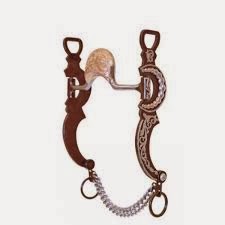
The spade bit is a signal bit.  It is designed to be carried by the horse, not worn, so that it lies on the tongue like a lozenge.  The copper wraps on the braces and the copper roller (cricket) all encourage the horse to actively carry that bit on a soft and supple tongue. The bit is rigged to a weighted set of rommel reins that are attached to the shanks of the bit by a set of rein chains.  This configuration allows for even minimal lifting or shifting of those reins to be transferred down to the spade bit in minuscule movements that the horse has been prepared to receive.  The first signal to the horse is when the spoon of the bit lifts off of the tongue (a movement of fractions of a millimeter) if the horse fails to respond to this signal, the following cue would be palette pressure of the spoon.  Because the leather (never chain) chin strap is adjusted much tighter than your average leverage bit, there is not much rock allowed on the spade bit and pressure that would force a horse's mouth open or drive that spoon into the pallet are prevented in such a way.


Much the opposite from the over exaggerated cues showcased in old western movies, the Vaquero of old prides himself on the inability of the observer to see the cues being given to the horse.
Ideally you want the level of communication between horse and rider to be so refined that the horse almost seems to respond from mere thought processes of the rider.

Obviously this takes a long time to cultivate.  On first impression this might appear to the novice as even more reason for such a large and imposing piece of equipment on such a finely tuned horse to seem like overkill.  After all, we have all watched Stacy Westfall's gorgeous reining pattern performed bareback and bridleless.   Shouldn't the bit become unnecessary in a properly trained horse?

Not to impinge Stacey's training or riding skills, I have the utmost respect for her, but the goal of a Vaquero is much, much different than performing a routine to music in an arena setting.  All well trained show horses should be able to perform adequately without a bridle if they have been well schooled in their job.  Texaco, Trevor Brazil's amazing calf roping horse, can perform out of the box equally well whether bridled or not.  There are impressive jumpers and dressage horses able to execute advanced maneuvers bridleless.  There are drill teams that execute complicated maneuvers bridleless.

Riding without a bridle is not the goal of a traditional Vaquero.  The spade bit is a badge of honor for the horse that has advanced in his training far enough to be awarded the trust to ride straight up in the bridle.  To be able to work with the finesse and deliberate intricacy showcased by the traditional bridle horse is a feat of training and communication with a fair bit of talent and ability on the horse's side.  Not all horses started in the hackamore and advanced into the two rein will become bridle horses.  Some just don't cut the mustard and remain an accomplished hackamore horse without ever moving beyond.  A true Vaquero doesn't allow the horse to be put in a position where failure is the only option.

The Vaquero bridle horse is not an arena horse, traditionally.  Not that a well trained bridle horse shouldn't be quite capable of performing dry work in an arena, but their end goal is to work cattle and to work cattle at the direction of the rider.  Unlike the Texas style of working cattle where the importance is placed on the cutter who will work the cattle on his own merit, the Vaquero prizes the horse that works in concert with the rider.  So cues, rapidly and quietly conveyed are the end goal.  While a Vaquero tries to keep the pace of working cattle quiet and calm, unpredictability is the rule not the exception when livestock are involved.  If things get a little "western" and the horse isn't able to respond to the slightest cue without a harder pull on that spade bit, the horse isn't ready and will continue to be worked in the hackamore or two rein set-up until he his.  Some Vaqueros choose to only bridle their horses when they know the work is intricate, yet controlled, and save the hackamore for work that is likely to be more fast paced with inadvertent rein pressure a possibility in the heat of the moment.  It all depends on the horse and the rider and the work to be done for the day.

The spade bit isn't the only traditional bit used by the Vaqueros.  Horses are individuals and they don't all respond the same way to the same bit.  A bit that may be perfectly balanced and fitted for one horse may be unsuited to that horse's stablemate.  For the aspiring Vaquero this is a challenge as finding just the right bit for your horse has much more to do with your horse's tastes than your own and it takes the hanging of several bits in your horse's mouth to find the one that he carries most comfortably.  Not a encouraging thought when each bit is such a finely wrought piece of working craftsmanship that you cannot simply go the tack store and pick one up.

Here are few of the other bits that maybe used by the Vaquero of both yesterday and today.

The Mona Lisa mouthpiece
 The half breed mouth piece


A properly balanced spade bit with rein chains and braided rawhide rommels is the ultimate in intricate communication between horse and rider.  The traditional Vaqueros communicated almost solely through this rein system disdaining use of the leg aids making immediate response to the bit of the utmost importance.  That is why anybody can learn to ride with out reins.  It is the accomplished Vaquero that learns to properly ride WITH them.  A crayon may get the job done when writing a letter, but isn't a calligraphy pen more elegant?

So, obviously the spade bit isn't the appropriate choice for the vast majority of horse and rider combinations out there today, but understanding the spade bit and the horseman that uses it will prevent you from unduly insulting what is likely to be a very accomplished horseman.  Good horsemanship speaks as loudly for itself as bad horsemanship and it is up the discerning horseman to ferret out the difference for themselves.


Sunday, February 16, 2014

You know what they say about opinions. . .

There are so many wonderful things that I have learned about horsemanship since beginning to follow the vaquero tradition.  It’s been an awakening of sorts for me and has effected each and every thing that I do with my horses and my patients.  Every once in a while you come across something so profound and life altering that it changes the way you look at almost every single thing in your life.  My horsemanship journey has been that for me.  It’s a wonderful, uplifting, challenging and rewarding experience.
 
The downside is that you also become aware of all the things that people do to their horses each and every day that go against the grain of everything that you now hold dear.  Ignorance is truly bliss.  Sometimes I wish I could go back to my days of riding in a dropped noseband with draw reins on a Pelham bit.  I thought I was so terribly advanced at that point and had properly mastered all these great additions to my tack room.  I knew just how to use every gadget, tie-down, martingale and assorted training aid that I had at my disposal.  “Tricks of the trade” so to speak. 

Now I know that there are no tricks.  Fast fixes don’t exist.  Every single thing that we do with our horses either builds or destroys the relationship that we are trying to create.  Every single interaction with your horse is meaningful.  This is both a very lovely thought and a terribly heavy burden.  What if you are tired, and in a hurry or your mind is somewhere else, or (gasp) you are on the phone while you are handling your horse?  What if this time you let him yank the lead rope out of your hand or walk off while mounting or toss his head during bridling?  What if you just don’t have time to fix it today? 

What it means is that you will have to work twice as hard to fix it tomorrow and three times as hard if you wait until next week.  

Like a reformed smoker, or born again religious zealot I find myself harshly judgmental of my friends and clients.  I’m not trying to be, honestly.  It’s just that I believe I have found a better way for the horse and it is so hard for me to watch horses that I don’t think are getting a fair deal because they ALL deserve a fair deal.  My friends know that I am pretty vociferous about my opinions.  I will tell people what I feel most of the time.  So, I find myself biting my tongue so much more than I used to because I can’t blame folks for not knowing.  It hasn't been that long since I didn't know any better myself.  Like any new convert, I'm sure that fire will fade with time until I can smile benignly at folks and help them to the best of my ability.  I'm working hard on that. 

When I first started on this journey I was very frustrated with the lack of information available.  How come I can’t just go to one web page or join some trainer’s special member’s only group and get a box set of DVD’s so I could learn this more quickly?  That’s how this horsemanship thing is done nowadays. I am a member of the generation of instant gratification! I understand now why it isn't that way with this style of riding and training.  There are  instructors out there if you go and look. Like the guru on the mountaintop they know that if you are willing to go the extra mile to find the answer, you may just be worthy of that answer.   You have to want it and you have to be willing to learn it slowly and by feel so that you can develop your feel and relationship with your horse.  You also have to buck today’s standards.  You aren't going to fit in with the trends in the show pen, any show pen, (with the possible exception of Cowboy Dressage) if you decide to ride this path.  Your horse isn't going to be completely broke in 60 easy step by step days.  You aren't going to play games with your horse and you aren't going to lope him until he begs you not to lope another step.  You aren't going to jab him in the ribs with each stride to make him wait on you for each command.  You aren't going to have to buy any signature tack.  You aren't going to win any futurities.

You can see why it isn't stylish in this day and age. 

Here is what you are going to do if you seek to better your horsemanship and riding skill through learning and understanding the traditions of the old vaqueros and the lessons of classical horsemanship.  You are going to learn to have a respect, dare I say reverence for the horse.  In this day and age of demanding respect from the horse, few are remembering to give that respect right back to the horse.  It needs to be a two way street.

You are going to learn to take things as slowly as is needed for the horse to learn and understand what is asked of it.  This means allowing a horse’s mind and body to mature before asking it to work like an adult horse.  This means allowing the horse the time and freedom to learn to search out the answer.  It means that 30 days doesn't equal a level of training, but is nothing more than a benchmark for how much time it took you to get to wherever you are today. 

You are going to learn to give your horse a job.  Horses are contextual learners.  They understand lessons best when they are paired with a job that they understand.  Make your horse’s training periods relative to a job that they understand and they will learn much faster. 

You are going to learn to communicate more effectively with your horse. If your horse isn't understanding what you are asking, more pressure is not the answer.  Is the horse ignoring your leg, or your hands?  A bigger bit of larger spur isn't the solution.  The problem is in your poor timing and feel. 

I could go on and on but quite frankly it’s just depressing.  It reminds me of a conversation that Buster McLaury related that Ray Hunt once had with a fellow that had recently been at one of Ray’s clinics.  The gentleman was full of the excitement and conviction of the newly converted.  He was enamored of Ray and all he could get done with a horse with no fight, no gimmicks and no rodeo.  He passionately told Ray that he believed that this information, once it got out to all the people, would completely revolutionize the horse industry.  Everybody out there would want to be part of this and change how they were with their horse.  Ray just as adamantly said, no sir, it won’t.  The gentleman was confused and asked Ray what he meant.  He answered that the problem with changing the way people interact with horses is that it’s the people that have to change, not the horse, and he didn't believe that would ever happen.   He was right. At least as far as mainstream horsemanship is concerned.  

I want to help people to find out if this way of being with their horses is what is best for them and their horse. I'm very happy to converse at length about the ins and outs of the bosal and how to use it effectively for softness and collection and why a spade bit isn't the torture device it's made out to be.  But,  I find myself frustrated when asked my opinion on a gag bit or if this two year old's knees are closed enough to start.  I am in a unique position as an equine professional in that I  find myself asked opinions on horsemanship and training as part of my veterinary examinations.  I can guarantee my answer isn't always going to be what you want to hear and it is likely to be the exact opposite of what your trainer told you.  I have to be careful to state my opinions in a way that differentiates between medical advice and horsemanship advice, because like in our schools, horsemanship training theologies and cold hard science don't mix very well.  It makes it very difficult for me when I am asked to preform procedures or administer treatments that I believe fly in the face of the horse's welfare.  Especially when other veterinarians will happily do it without hesitation.  

I am in it for the horse.  From sun up to sun down, my husband and I eat, sleep and breath horses. (that sounds terrible, we don't eat horses, but you get my meaning, I'm sure.  Don't want to feed that rumor mill!)   We care for them from conception to the grave making their health and welfare our primary concern.  When I see practices that I believe to go against the overall welfare of the horse it's next to impossible for me to shut up about it.  But I do.  More often than you know.  So, just remember when you ask my opinion I'm likely to tell you exactly what I think.  Be sure you are ready for that.  


Wednesday, January 29, 2014

One hand, Two Hand, No Hands, Soft Hands

Imagine if a piano player was restricted once achieving a certain level of training to only playing with one hand.  Sure you can make beautiful music with just one hand but why limit yourself in such a way?  While many of you may not be aware of it, a great heated debate is waging right before you in the horsemanship world that is just as silly as limiting a piano player to just one hand.  There are folks quite passionate about riding a western horse in just one hand to the point of accusing those riding in two hands as being ignorant and even abusive!

I know it sounds kind of silly to be making such a big deal about this.  Folks in the english world are likely scratching their heads at these cowboys wondering what in the world is the big debate.  Well, to understand the source of the debate you have to understand that all things horsemanship are seated in deep traditions and those traditions are harder to change than the color of the sky.

 Look at what side of the horse we mount on, for example.  It's considered poor form to mount from the right because knights mounted from the left so their sword wouldn't get in the way and we are STILL mounting from the left. I Can't remember the last time I had to fight with my sword while mounting, but I can tell you it feels weird when I mount from the right. 


But we aren't talking about swords today, we are talking about hands and how we should be using them.  Let's start at the beginning.  In starting all horses in all traditions, be it english, western, vaquero; the horse is started using two hands to make things simpler for the horse to understand.  Folks riding english have a marvelously simple bit called the snaffle that is used with two hands so that direct simple rein pressure commands can be communicated to the horse.  That same simple bit was adopted by the folks in the western traditions for it's simplicity and ease in communicating with the horse.  While many of the traditional vaquero folks shun the snaffle bit as non-traditional, they do ride with two hands with the horse in the hackamore to ease in communication until good rein signal is established. 

Riding with two hands makes perfect sense when riding with a bit that works off of direct pressure as almost all bits will to a certain extent.  You can use light, soft hands with give and feel to help shape the horse into a correct form.  If your entire goal with your horse is to head off down the trail in a straight line, one hand is quite sufficient regardless of the bit because creating shape and form in your horse is entirely unnecessary.  But, if you are riding for correctness of form then two hands and two legs is very useful, nae, necessary, in order to help your horse reach it's full potential.  Anybody who has watched a John Wayne movie has seen how one hand on the reins in a western bit can be quite harsh.  If any of those cowboys had reached down and softly bent the nose in the direction they were going before turning and galloping away rather than reefing the horse's head almost upside down as they cranked across the neck with one hand it would have made the whole picture much more pleasing.  But, that's just not how cowboys ride!

So why would it become a tradition in western disciplines to ride our horses with one hand?  Is it because of the big bits that we use that somehow become damaging with two hands on the reins?  Definitely not.  Look at all the metal an upper level classical dressage horse has in his mouth with two very tight hands on the reins. Look at a park horse parading around with the ring with a double bit and two hands on the reins.


 Look at the gaited horse community that show with large shanked bits and two hands on the reins.  The sole reason that western riders ride with one hand on the reins is because the other hand is supposed to be engaged in something else.  That is the entire reason.   Cowboys rope.  So if you are working cattle and roping it is incredibly important that you are able to control your horse adequately with one hand on the rein. 


I'm going to bring the vaquero tradition into the conversation for just a moment because this is one area where this debate is most heated, and for good reason.  The vaquero tradition is all about building elite cow horses.  These are horses that are meant to work off of the lightest signal of the rein for lightning fast reflexes.  They take years and years of concentrated and specialized training and the mark of their achievement is to be "straight up" in the bridle operating with precision and grace off the mere lift of a single hand perfectly positioning their rider to work a cow or rope a calf.   For these folks the tradition is everything.  They stick to tradition in dress, gear and training of their horses.  It is considered poor form to touch the bridle reins with the other hand not because you are afraid of the spade bit the horse is wearing but because of tradition.  You would no more touch the reins with your free hand than you would wear a bowler hat or ride in a cordura saddle.  Tradition. Plain and simple. 

But, aside from the strict traditions of the vaqueros the rest of the western disciplines have had to adopt this method of riding with one hand as well.  Even if these horses will NEVER see a cow in their lifetimes or those riders have no business swinging a rope! 

If we look at the western pleasure discipline you see riders in long draped reins with no ability to communicate effectively with their horse riding around the ring with one eye on the judge waiting for their opportunity to reach down with one hand and correct their horse or lift the reins over their head to bump that head down.  A good showman learns that you sneak a little inside rein with one finger when you are going around a corner to help round your horse.  What do you see in the warm up pen?  A bunch of folks riding around with two hands on the rein schooling their horses getting them ready for the show ring so that they can ride with one hand.

It's utter poppycock.  If your horse preforms more correctly with two hands on the reins then by all means ride with two hands on the reins.  This is one of the beauties of Cowboy Dressage and one of the things that so many people find so attractive about it.  There aren't rules about how many hands you can use with what type of bit.  If we are schooling our horses in correctness and lightness you should be able to help your horse in anyway that you can not only in the warm up pen but in the show pen as well. 

While is true that a well trained western pleasure horse can ride a pretty pattern with a draped rein and one hand, he can't do that pattern with a completely collected and rounded frame, arching in the circle and maintaining that arc then coming straight and collected through the half pass.  That takes aids, and help and two hands on all but the most advanced horses. 

But what about the bits?  Aren't shanked western bits too harsh to use two hands on?  Poppycock.  Sit around a western pleasure ring sometime and watch the way those riders bang on those horses with those great big bits.  That's harsh.  Cowboy dressage is all about light hands.  Any bit in poor hands can be harsh, just like any bit in good hands can be soft.  It's not he device but that hands wielding them that make the difference.  When you are learning to work with your horse with softness and feel it doesn't matter what kind of bit you are using.  Even the traditional spade bit of the vaqueros can be used softly with two hands without endangering the horse.  Cowboy Dressage encourages the use of hinged western bits that allow for independent movement throughout the mouthpiece.  Those bits are designed to be used most effectively with two hands working in lightness and correctness to create bend and suppleness throughout the entire body.  Those bits offer distinct advantages to the cowboy dressage rider over traditional spade bits or hooded half breed that are used in the western pleasure ring. 


What about the new trend of all the bridleless riding?  Should that be the end goal of any great horseman?  I don't believe so.  As a follower of the vaquero tradition, I believe the end goal of any great horseman should be to ride with softness and feel in the bit.  To be able to properly train your horse to be completely responsive and correct in the spade bit takes real horsemanship.  Not to make light of the great training that goes into making a horse listen to your body cues independent of a bit but it isn't as difficult as some might believe.  Horses are great at responding to changes in our body and leg position.  Good riders, I believe, make changes in our body while we are riding without even thinking about it and a horse learns to interpret these changes even when the signal with the bit isn't given.  Anybody can learn to ride without a bit, but it takes a real horseman to learn to properly ride with one. 

So what is my take on the great debate, especially since I am a follower of the vaquero tradition of bridle horses yet also a believer in Cowboy Dressage where two hands on the reins are not only allowed but encouraged? I believe it's all in the ability of the rider to ride with soft hands and feel.  I want correctness and softness in my horses above and beyond everything else that I do with them.  While I am working towards having my horse straight up in the bridle eventually, we will be working towards that goal with two hands softly directing and correcting until my horse can carry himself with collection and softness.  I love tradition.  It's fun to learn about how things have always been done and honoring our ancestors by upholding tradition is great.  But if you fly in the face of progress and reality for the pure sake of maintaining traditions that don't apply to you, that's ridiculous.  I believe that you should know how to mount your horse from both sides and how to properly ride your horse with two hands on the reins with lightness and feel no matter what type of gear you choose to ride in or what traditions you choose to follow. 

I believe there is a place for the vaquero tradition in Cowboy Dressage.  I believe there is a place for every type of western rider in Cowboy Dressage.  The pursuit of correctness and softness and light hands can benefit every single western rider out there.  I think it's time for a new tradition in the western disciplines.  It's time for lightness to become the tradition that surpasses all others.